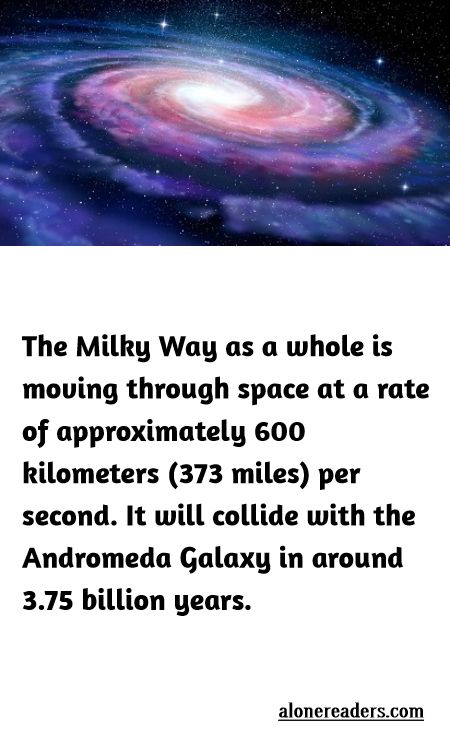
The Milky Way, our galactic home, is not static in the universe; it moves through space at a stunning speed of around 600 kilometers per second, or approximately 373 miles per second. This motion is part of the dynamic and ever-evolving nature of the universe, where galaxies are in constant motion, drawn together or apart by gravitational forces.
Among the most fascinating future events involving our galaxy is its predicted collision with the Andromeda Galaxy, which is our closest galactic neighbor. This monumental event is expected to happen in about 3.75 billion years. Both the Milky Way and Andromeda are part of the Local Group, a galaxy cluster that includes several smaller galaxies, and are being pulled toward each other by their mutual gravitational attraction.
The collision of these two spiral galaxies is an event of cosmic proportions. It is forecasted that as they merge, the supermassive black holes at their centers may eventually combine, and the stars within them will be thrown into new orbits but are unlikely to collide directly due to the vast distances between them. Instead, the merger will more likely see a mixing and redistribution of stars and gas, possibly giving birth to new stars as gas clouds collide and compress.
Interestingly, rather than seeing a catastrophic destruction, this merger will probably result in the formation of a new, larger elliptical galaxy. Astrophysicists suggest that our solar system's position in the galaxy might shift, but is likely to remain intact. However, from Earth’s vantage point—if our planet still exists—the night sky would dramatically change, offering spectacular cosmic views.
This event reminds us not only of the scale and continual change inherent in our cosmos but also of the intricate dance of gravitation and momentum playing out across eons, reshaping the structure of the universe in slow motion. It is a clear demonstration of the dynamic universe we are part of, continuously evolving, reorganizing, and transforming over billions of years.
