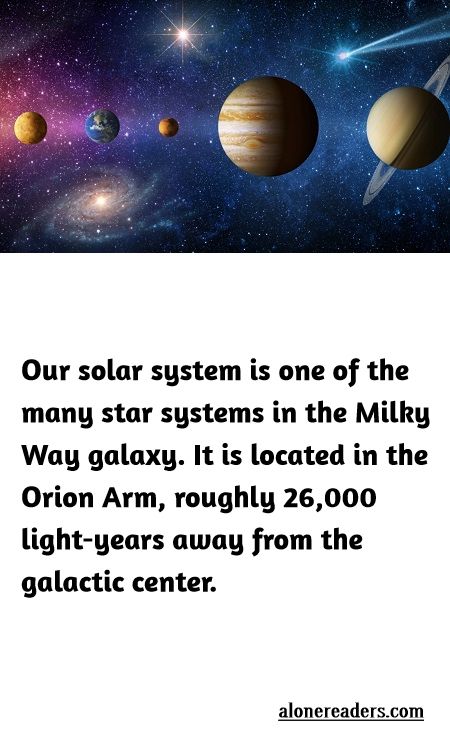
Our solar system, a mesmerizing collection of planets, moons, asteroids, and comets orbits a lone star we know as the Sun. This system resides in a relatively quiet part of the Milky Way galaxy known as the Orion Arm. It is positioned about 26,000 light-years away from the bustling center of the galaxy, offering us a unique vantage point to observe the cosmos.
The Milky Way, a spiral galaxy, contains billions of stars and countless planetary systems, yet our solar system holds a special place with its diverse planetary dynamics. The planets, ranging from the small, rocky bodies of the inner solar system like Mercury and Venus to the gas giants like Jupiter and Saturn, showcase the extraordinary variety of celestial configurations. Moreover, the presence of Earth, with its unique atmosphere and biosphere, presents profound implications for understanding life's potential across the universe.
Exploring our solar system offers contextual insights into the larger mechanisms at work in the Milky Way. For instance, the Sun's influence through its solar wind shapes a vast bubble known as the heliosphere, which shields the solar system from cosmic radiation. This bubble is indicative of interactions that other stars may have with their surroundings, influencing the conditions and habitability of planets in their orbit.
The position of our solar system far from the galactic center is also significant. Regions closer to the center face greater cosmic activity, including higher concentrations of potentially harmful radiation and more frequent gravitational disturbances. Being situated in the quieter Orion Arm allows our solar system to maintain relative stability, favorable for life on Earth to flourish over billions of years.
As astronomers push the boundaries of technology to peer deeper into other planetary systems and compare them with our own, understanding the placement and composition of our solar system helps in making sense of the complex tapestry of the Milky Way. Each discovery feeds back into our grasp of where, in this vast and dynamic galaxy, conditions might be ripe for life as we know it.
