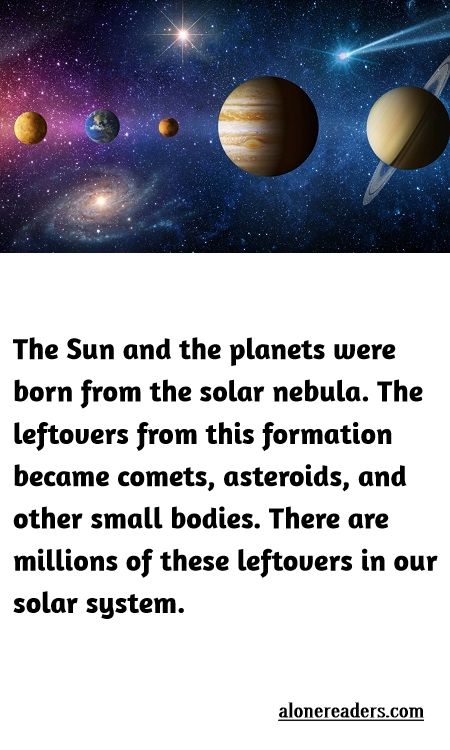
The solar system's formation is a fascinating tale of celestial evolution that began with a rotating cloud of gas and dust known as the solar nebula. About 4.6 billion years ago, this nebula collapsed under its own gravity, which initiated the birth of the Sun and the surrounding planets. The process was not a clean sweep as it left numerous remnants, which we now identify as comets, asteroids, meteoroids, and other smaller celestial bodies scattered throughout our solar system.
These remnants are more than just space debris; they are crucial to understanding the early solar system's conditions and the processes that shaped it. Comets, often termed as 'dirty snowballs', consist mostly of ice and dust. When they orbit closer to the Sun, they heat up and release gases and dust into space, creating visible tails that can be seen from Earth. Asteroids, on the other hand, are rocky or metallic and inhabit mainly the asteroid belt between Mars and Jupiter. Their compositions vary significantly, suggesting that they might be the pieces of once-larger bodies that broke apart due to collisions or gravitational influences.
Then there are meteoroids, which are significantly smaller fragments that sometimes enter Earth's atmosphere, appearing as shooting stars when they burn up and occasionally reaching the surface as meteorites. Both comets and asteroids have been subjects of space missions which aim to study their compositions and trajectories. For instance, NASA's OSIRIS-REx mission to the asteroid Bennu intends to return samples to Earth, helping scientists delve deeper into the solar system’s past.
Understanding these diverse objects is vital not just for scientific curiosity but for practical reasons as well. For example, learning about asteroid compositions and behaviors helps develop strategies for Earth defense against potential hazardous impacts. Moreover, studying these celestial bodies can unlock possibilities of mining them for resources as our technological capacity expands.
Thus, while they may be leftovers from the solar system’s formation, comets, asteroids, and other small bodies hold indispensable clues to our cosmic neighborhood’s history, composition, and future. They remind us that even in the vast emptiness of space, everything has a role and a story, contributing to the broader narrative of our universe.
