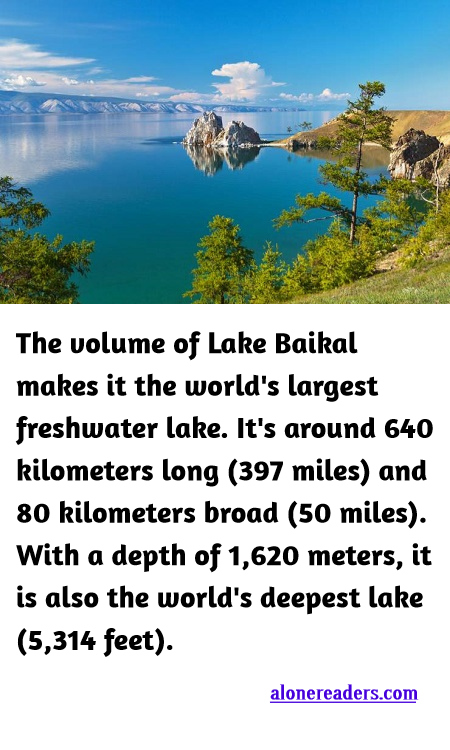
Lake Baikal, a crescent-shaped rift lake located in Siberia, Russia, stands as one of the most remarkable natural wonders on Earth. Renowned not only for its size and depth, Lake Baikal holds the title as the world’s largest freshwater lake by volume. It contains about 23% of the world's fresh surface water which is more than all the North American Great Lakes combined. Stretching approximately 640 kilometers in length and 80 kilometers at its widest point, its vast expanses are impressive by any measure.
However, what truly sets Lake Baikal apart is its depth. At its deepest point, the lake reaches down to 1,620 meters, making it the deepest lake in the world. This incredible depth is due to its origin as a rift valley, continuously widened by the tectonic movement, which deepens the lake as the Earth’s crust slowly pulls apart. This geological activity also makes Baikal one of the clearest lakes in the world, with visibility down to great depths.
Beyond its geographical and geological characteristics, Lake Baikal is also a biodiversity hotspot. It hosts thousands of species of plants and animals, many of which are endemic to the area. Perhaps the most famous of these is the Baikal seal, or nerpa, the world’s only species of freshwater seal. This unique ecosystem is delicately balanced, making it a focal point not only for ecology but also for studies on environmental change.
The cultural and historical importance of Lake Baikal adds another layer to its significance. The lake is considered sacred by the local indigenous populations, and it is a central part in many local myths and legends. Furthermore, the lake area has been a hub for scientific research for many decades, offering insights into limnology, evolutionary biology, and even climate science.
Due to its unique properties and significant global importance, Lake Baikal was declared a UNESCO World Heritage Site in 1996. It attracts tourists, scientists, and nature enthusiasts from around the world, who come to marvel at its deep, pristine waters and the life forms it nourishes. As such, it continues to be a beacon of natural beauty and a critical resource for scientific understanding, amidst growing concerns over environmental sustainability and protection.
