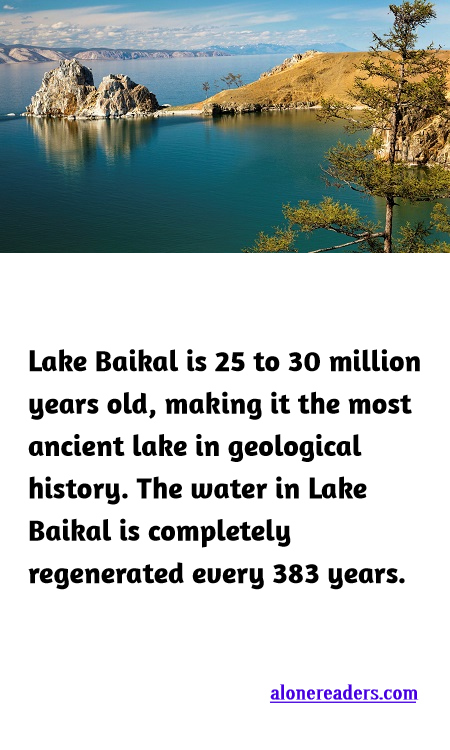
Nestled in the Siberian region of Russia, Lake Baikal is not only the world’s deepest and oldest freshwater lake, but also a reservoir of unparalleled natural history. With an estimated age of 25 to 30 million years, Lake Baikal holds the title for the most ancient lake in geological history. This incredible age allows the lake to offer a unique glimpse into the planetary processes and ecosystems of the distant past.
Lake Baikal is extraordinarily deep, plunging to depths of over 1,642 meters (about 5,387 feet), which contributes to its massive volume, accounting for nearly 20% of the world's unfrozen freshwater reserve. This immense depth is a product of its origin as a rift lake, formed by the gradual pulling apart of the Earth's crust. This rifting process is still active, causing the lake to slowly widen and deepen over time.
The water of Lake Baikal is known for its clarity and purity. Surprisingly, despite its size and depth, the lake’s entire volume of water is completely regenerated every 383 years. This is primarily due to the large number of tributary rivers – over 300 – that bring fresh water into the lake, and the sole outlet, the Angara River, through which water leaves. This natural filtration process contributes to the clarity and purity of its waters, which are among the clearest of any natural body on Earth.
The lake also supports a unique and diverse ecosystem with thousands of plant and animal species, many of which are endemic to the area. The most famous among these is the Baikal seal or nerpa, which is the only freshwater seal species in the world, a fact that intrigues scientists and conservationists alike.
Given these characteristics, Lake Baikal is not only a natural wonder but also a valuable scientific resource, offering insights into climate change, evolutionary biology, and earth science. Its pristine environment and ancient waters continue to be a focus for scientific research and a magnet for tourists drawn by its mysterious beauty and ecological significance. Despite facing environmental threats, efforts continue in earnest to preserve this unique natural treasure for future generations.
