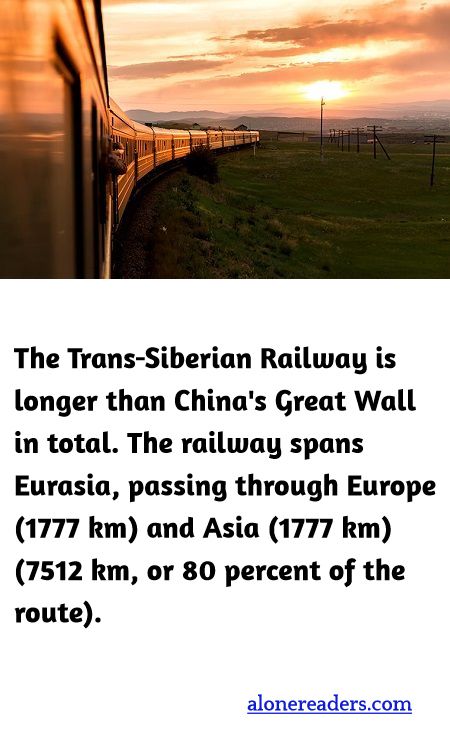
The Trans-Siberian Railway, a marvel of engineering and logistical planning, stands as a monumental testament to human endeavor and a vital artery connecting the vast expanses of Russia. Spanning an impressive length that surpasses even China’s Great Wall, the railway stretches approximately 9,289 kilometers from Moscow in the west to Vladivostok in the east. This makes it the longest railway line in the world, edging out the Great Wall, which is about 21,196 kilometers long if all its branches are included.
Initiated under the rule of Tsar Alexander III and completed during the time of Nicholas II, construction of the Trans-Siberian Railway started in 1891 and took about 25 years to complete. This colossal project was not just an exercise in expanding Russia’s infrastructure but also a strategic move to consolidate its influence in the far eastern territories and provide a continuous land link between Europe and Asia.
The railway's route is predominantly through Asia, covering about 7,512 kilometers or approximately 80 percent of its total length, with the remaining 1,777 kilometers traversing through European Russia, acting as a bridge between the two continents. The journey along the Trans-Siberian Railway presents travelers with a unique opportunity to witness firsthand the changing landscapes, from the dense forests of Siberia to the expansive steppes of Mongolia and the rugged mountains of the Ural region.
Functioning not only as a passenger route, the Trans-Siberian Railway is crucial for freight transport, facilitating the movement of goods between the Pacific and the European markets. It connects with several other railways, including the Trans-Mongolian Railway, which diverts to Beijing, and the Trans-Manchurian Railway, branching towards northeastern China, thus making it an integral part of Eurasian trade and travel networks.
Despite its utilitarian purposes, the Trans-Siberian Railway also offers a cultural journey, exposing travelers and goods to diverse communities and traditions along its route. This continuous interaction has fostered a sense of connectivity amongst the remote regions of Russia, binding the vast country more closely together while simultaneously opening it up to the world. As it remains a symbol of Russia’s historical ambitions and current might, the Trans-Siberian Railway continues to be not only a critical component of global railway systems but also a journey that encapsulates the spirit of adventure and the endless human quest to bridge distances and cultures.
