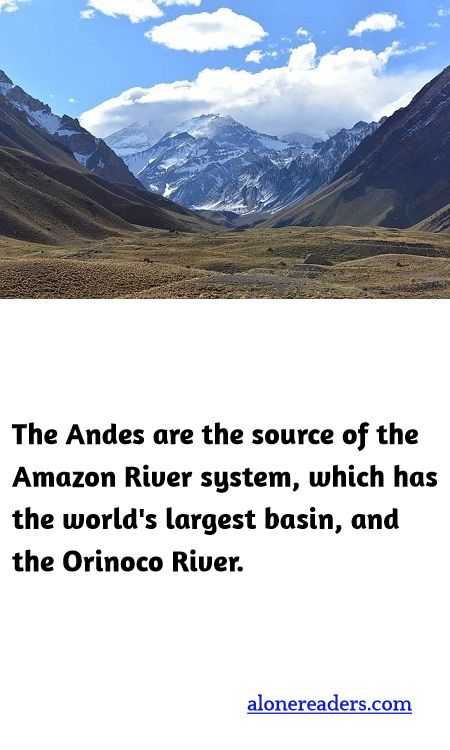
The Andes Mountains, a formidable range stretching along the western edge of South America, are not only known for their breathtaking vistas and diverse ecosystems but also as the birthplace of some of the world’s most significant rivers. Among these, the Amazon and Orinoco Rivers stand out, each originating from this mountainous spine and playing crucial roles in their respective regions.
The Amazon River, renowned as the lifeblood of the largest rainforest on Earth, begins its journey in the Peruvian Andes. The Apurímac River, considered by many as the most distant source of the Amazon, rises from the Nevado Mismi mountain at an impressive altitude around 5,597 meters above sea level. This marks the beginning of an epic journey where the river snakes through Peru, Colombia, and Brazil, eventually emptying into the Atlantic Ocean, covering over 6,400 kilometers. The Amazon River system encompasses the largest river basin in the world, an area that surpasses the size of the next two largest basins combined, the Congo and the Nile. This basin is instrumental in supporting the Amazon rainforest, housing an incomparable biodiversity and serving as home to thousands of species, some yet unrecorded by science.
On the other hand, the Orinoco River, another major water system of South America, also finds its sources in the Andes’ labyrinth of peaks and valleys. It primarily flows through Venezuela before its delta spreads out into the Atlantic Ocean near Trinidad and Tobago. Like the Amazon, the Orinoco plays a vital role in its region, supporting diverse habitats including the Orinoco Delta swamp forests and the Llanos grasslands. These environments are crucial for countless species of flora and fauna as well as indigenous human communities who depend on the river for their livelihood.
The environmental significance of these river systems extends beyond biodiversity. The Amazon and Orinoco rivers are pivotal in regulating climate patterns in their regions and globally. The Amazon, for instance, is known as the "lungs of the Earth," producing more than 20% of the world’s oxygen, while the extensive wetlands of the Orinoco act as carbon sinks, absorbing carbon dioxide from the atmosphere.
The starting points of these rivers in the Andes highlight the interconnectedness of natural systems. The geography of the Andes not only shapes the climate and ecology of South America but also has a direct influence on global environmental health. This connectivity emphasizes the importance of preserving environments like the Andes and the river systems they nurture, reminding us of the critical and global nature of environmental protection efforts.
