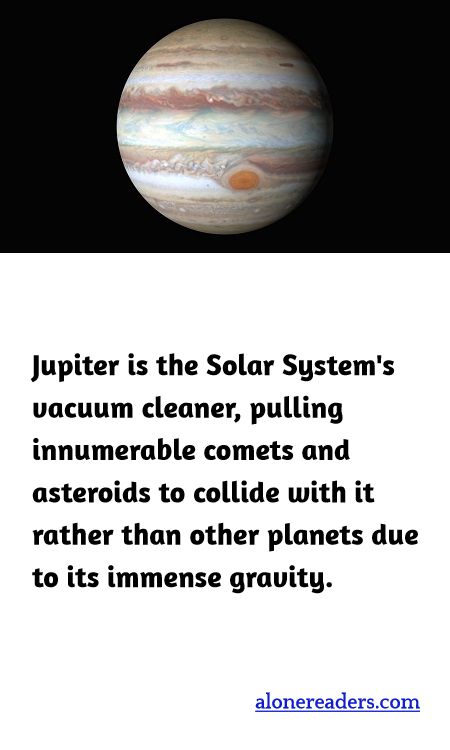
Jupiter, often referred to as the giant protector of the solar system, plays a crucial role that extends beyond its stunning appearance and massive size. Known for its immense gravitational force, this colossal planet acts like a cosmic vacuum cleaner. Jupiter's gravity is so strong that it influences the paths of comets, asteroids, and other space debris, drawing them in to collide with it rather than allowing them to potentially slam into Earth and other inner planets.
This giant planet, the largest in our solar system, serves as a sort of shield, its gravitational pull either capturing these potentially dangerous objects or slinging them back into the outer reaches of space. This protective mechanism is vital for the safety of Earth, mitigating the number of massive impacts that could otherwise threaten life as we know it. For instance, the famous impact of Comet Shoemaker-Levy 9 in 1994, where fragments of the comet spectacularly collided with Jupiter, provided a direct observation of Jupiter's gravitational might in action, and how it influences our cosmic neighborhood.
The presence of Jupiter may have also been crucial in the early solar system. The planet's strong gravitational pull likely helped to stabilize the orbital paths of the inner planets, including Earth, and to reduce the number of high-speed comets darting through the inner solar system. This not only minimized the impact rate on Earth but also could have played a significant role in allowing stable conditions to persist long enough for life to develop.
Thus, Jupiter’s role as the solar system's vacuum cleaner is more than just a fascinating astronomical fact; it's a fundamental part of why Earth has been able to maintain relatively stable and conducive conditions for life. Jupiter's existence emphasizes the interconnected nature of celestial bodies and underlines the delicate balance within our solar system that supports life on Earth. This understanding further enriches our appreciation of both the complexity and the fragility of our cosmic environment.
