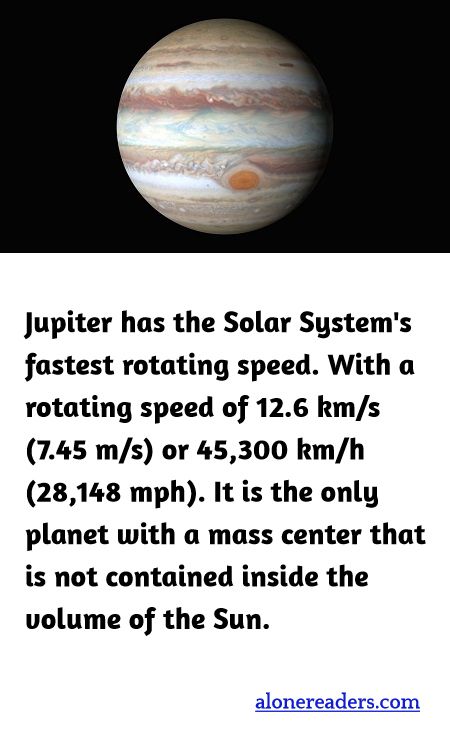
Jupiter, the largest planet in our Solar System, displays some remarkable features that set it apart from other celestial bodies. One of its most astonishing characteristics is its rapid rotation. Jupiter spins at a remarkable speed of 12.6 kilometers per second (approximately 7.45 miles per second), translating to about 45,300 kilometers per hour (around 28,148 miles per hour). This fast rotational speed makes Jupiter the fastest-spinning planet in our Solar System.
The rapid rotation of Jupiter has significant implications for its physical structure and atmospheric dynamics. Its high speed causes the planet to exhibit a pronounced flattening at the poles and bulging at the equator. This equatorial bulging is due to the centrifugal force generated by the planet’s rotation, which slightly deforms its shape.
Moreover, this swift rotation greatly influences Jupiter’s weather patterns and atmospheric phenomena. Jupiter is famous for its Great Red Spot, a gigantic storm system perpetually swirling in its atmosphere, which has been observed for over 400 years. Scientists believe that the planet's rotation contributes to the persistence and intensity of this and other vortexes within its gaseous envelope.
An equally interesting aspect of Jupiter is its mass distribution in relation to the Sun. Uniquely among the planets in our Solar System, the center of mass with Jupiter and the Sun actually lies just above the Sun's surface rather than inside it. This means that both Jupiter and the Sun orbit a mutual point in space that is outside the Sun's volume, emphasizing Jupiter's significant mass relative to the Sun.
These unique characteristics highlight Jupiter's role and influence within our Solar Solar System, marking it as a planet of interest and importance in celestial studies and observations. As technology and space exploration advance, understanding the nuances of such massive planets will be crucial in unraveling more about our cosmic neighborhood.
