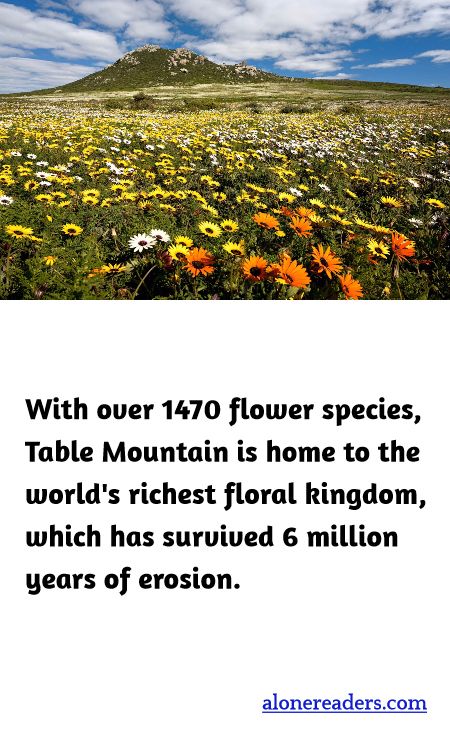
Table Mountain, a prominent landmark overlooking the city of Cape Town in South Africa, is not just remarkable for its flat-topped peaks which reach approximately 1,085 meters above sea level, but also for hosting an extraordinary diversity of flora. It is considered a global biodiversity hotspot thanks to its collection of over 1470 identified species of flowers. This is more floral variety than what can be found in the entire United Kingdom, making it the world's richest floral kingdom contained entirely in a single geographic location.
This floristic region, predominantly covered by fynbos, an evergreen, hard-leaved shrubland or heathland vegetation, thrives in the area's Mediterranean climate. The biodiversity is astounding and highly adapted to the local conditions. Among these are several species of proteas, ericas, and restios that are unique to the region and cannot be found anywhere else on the planet. The resilience and variety of this ecosystem are the results of millions of years of development.
Table Mountain's remarkable biodiversity has survived 6 million years of erosion and other natural challenges. This long period of botanical evolution in relative isolation, combined with the challenging weather conditions of the Cape, has fostered the development of a wide range of plant species adapted to specific ecological niches. The mountain itself provides a range of microclimates and varying soil types which further support the diversity of plant life.
For nature lovers, conservationists, and scientists, Table Mountain offers valuable insights into evolutionary biology and the impacts of climate change on biodiverse systems. The area serves as both a research haven and a conservation challenge, balancing public access with the need to preserve its fragile ecosystems. Efforts to maintain and protect this vital biodiversity reserve are crucial, as it not only supports ecological health but also sustains the cultural heritage and tourism economy of Cape Town. From guided hikes to educational programs, initiatives are in place to ensure that this unique floral kingdom continues to flourish for generations to come.
