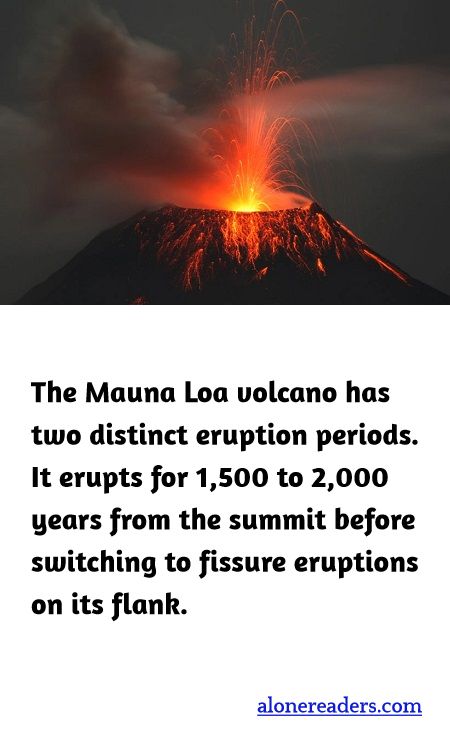
Mauna Loa, one of the most active volcanoes in the world, is located on the Island of Hawaii. This colossal volcano, which rises 13,678 feet above sea level, has demonstrated a unique eruptive pattern that geologists have studied extensively. The volcanic activity of Mauna Loa is characterized by two distinct eruption periods: prolonged summit eruptions followed by shorter-lived eruptions along its flanks.
During the first phase, Mauna Loa erupts for about 1,500 to 2,000 years from its summit caldera, known as Moku‘aweoweo. This lengthy period is marked by the slow, effusive release of basaltic lava, which flows freely and spreads over great distances. These flows contribute significantly to the growth and reshaping of the volcano's overall structure.
Following the summit eruptions, Mauna Loa’s activity typically transitions to the second phase, which involves eruptions from radial fissures on its flanks. These fissure eruptions are generally more dynamic and less predictable than the summit eruptions. The flank period involves the opening of vents along the sides of the volcano, from which lava rapidly escapes and flows down the slopes. This phase is considerably shorter compared to the summit eruptions, yet it plays a crucial role in the dispersion of lava and the expansion of the island.
This cyclical pattern of eruptive behavior offers valuable insights into the underlying magmatic processes of Mauna Loa. The transition between summit and flank eruptions is influenced by a variety of geological factors, including changes in magma chamber pressure, tectonic stresses, and the structural integrity of the volcano itself. As magma builds up in the shallow chamber beneath the summit, it eventually finds less resistance along the weaker zones away from the central conduit, leading to flank eruptions.
Understanding the eruption patterns of Mauna Loa is crucial for volcanic hazard assessment and planning in Hawaii. As Mauna Loa is not only an active volcano but also one of the largest on Earth, its eruptions can have significant implications for residents and the environment. Accurately predicting these transitions between eruptive phases helps scientists and local authorities mitigate volcanic risks effectively.
This dual-phased eruptive behavior of Mauna Loa underscores the dynamic nature of volcanic activity and reflects the complex geological processes that operate beneath such massive volcanoes. By continuing to monitor these patterns, researchers aim to further unravel the mysteries of Mauna Loa’s periodic behavior and its impact on the evolving landscape of Hawaii.
