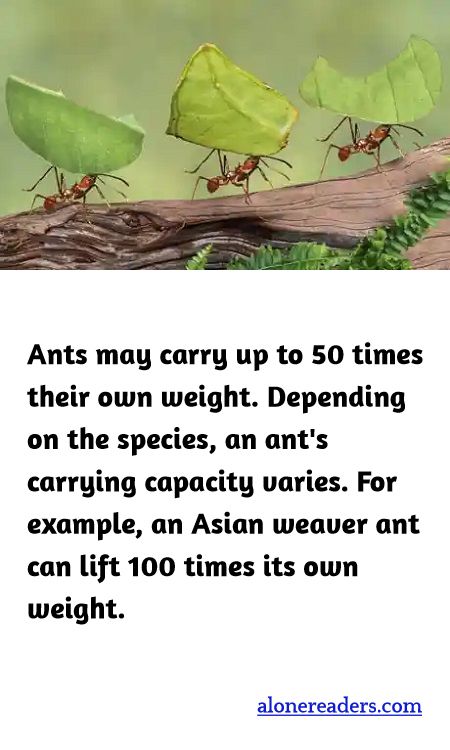
Ants, known for their remarkable strength relative to their size, exhibit one of the most fascinating displays of power in the animal kingdom. This incredible ability to lift and carry objects significantly heavier than themselves is not just a curiosity—it plays a crucial role in their survival. The degree to which ants can bear weight greatly exceeds what one might expect from such small creatures, with some species capable of carrying up to 50 times their own body weight.
This strength is particularly pronounced in certain ant species. For instance, the Asian weaver ant stands out as a formidable lifter within the ant community, having the capacity to hoist up to 100 times its own weight. This is equivalent to a human lifting about two compact cars, showcasing the extraordinary physical capabilities of these insects. Weaver ants achieve this feat through a combination of strong muscles that are proportionally larger compared to their body size and a mechanical advantage given by their smaller structures.
Biologically, ants are equipped with exoskeletons, which provide leverage and support for carrying heavy loads. The distribution of their muscle mass allows them to exert force more effectively. Additionally, these insects are structured with powerful mandibles which are not only critical in acquiring and processing food but also essential in carrying objects back to their colonies. Whether it’s food, building materials, or even relocating their young, the ability to transport various items is vital for the colony's sustenance and growth.
What’s even more impressive is the cooperative nature of ants when it comes to transport. While individual ants exhibit impressive strength, some species coordinate as groups to move large items. By working together, they effectively distribute the weight and manage bigger loads, optimizing the path back to their nest by adjusting dynamically to the changing environment.
Ants' weight-carrying capabilities are more than just a natural wonder; they represent a critical evolutionary advantage that has allowed ants to thrive in diverse and competitive environments. This strength plays a pivotal role in their ability to construct intricate nests, wage war against competing colonies, and ensure the survival through efficient resource management. It’s a vivid demonstration of how even the smallest creatures can achieve monumental feats through adaptation and teamwork.
