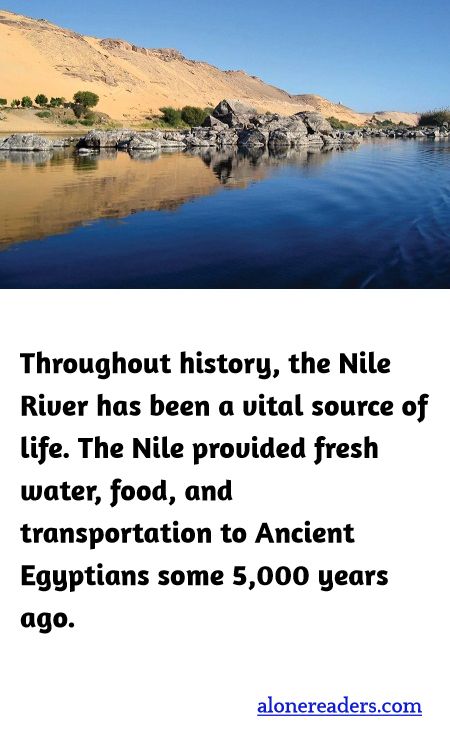
The Nile River, flowing through northeastern Africa, is the longest river in the world and has been an essential lifeline for civilizations since ancient times. Its significance to the Ancient Egyptians cannot be overstated; it was crucial for their survival, culture, and development. The river’s predictable flooding cycle deposited rich, fertile silt onto the banks, creating an agricultural paradise that allowed the Egyptians to cultivate surplus crops. This agricultural bounty freed them to pursue other endeavors, enabling the development of one of the world’s earliest and most influential civilizations.
Around 5,000 years ago, the Ancient Egyptians began harnessing the Nile’s resources, developing sophisticated irrigation techniques to extend the river’s reach. This technological prowess turned the harsh desert landscape into arable land. Communities sprouted along the river’s length, unified by the dependency on the Nile’s waters, which facilitated the emergence of unified kingdoms under pharaohs such as Narmer, who is often credited with unifying Egypt.
Moreover, the Nile was the economic superhighway of Ancient Egypt. Boats loaded with stone, grains, gold, and other goods traveled the river routes, enabling trade and communication between distant regions of the empire and beyond. This bustling waterway fostered not only economic prosperity but also cultural exchanges, spreading ideas, beliefs, and innovations along the river.
In addition to providing for physical sustenance and economic prosperity, the Nile also held a deeply spiritual significance for the Ancient Egyptians. They believed the river was a divine gift from the gods and incorporated it into their mythology and religious beliefs. The Nile was thought to be connected to the underworld and the afterlife, making it a central element of Egyptian cosmology. Annual flooding was celebrated as a renewal of life, symbolizing the regeneration of the fields and by extension, the kingdom itself.
Even today, the Nile continues to serve as a crucial resource for modern Egypt and several other countries through which it flows, supporting millions of people. Its historical and cultural significance endures as a testament to its impact on human civilization. The story of the Nile River is not just a chapter in Egyptian history, but a continuous narrative of human ingenuity and adaptation in the face of nature’s vast power.
