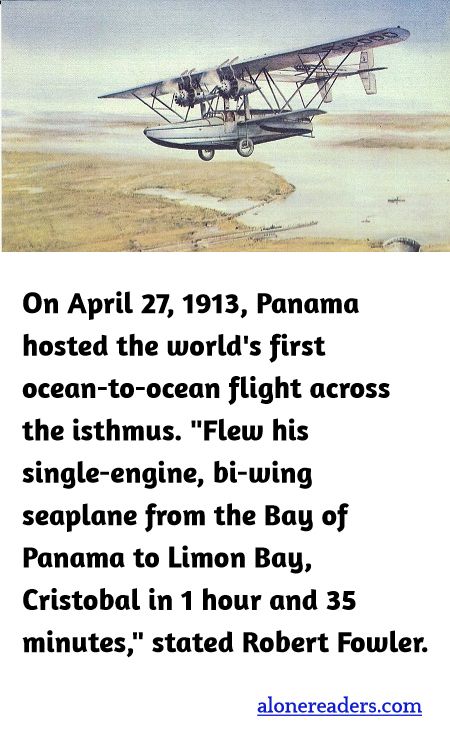
The historic event of April 27, 1913, marked a significant milestone in the annals of aviation and engineering, when the world witnessed its first ocean-to-ocean flight across the narrow stretch of land known as the Isthmus of Panama. This extraordinary feat was accomplished by the daring aviator Robert Fowler, whose flight bridged the aquatic expanses from the Bay of Panama on the Pacific side to Limon Bay in Cristobal on the Atlantic side.
Piloting a single-engine, bi-wing seaplane, Fowler made the journey in just 1 hour and 35 minutes, a remarkably swift passage considering the technological limitations of early 20th-century aviation. The isthmus, spanning approximately 50 miles at its narrowest point, presented a unique opportunity for such an endeavor. Fowler’s successful crossing not only demonstrated the capabilities of newer aviation technology but also highlighted the strategic importance of Panama as a link between the two vast oceans.
The flight occurred just months before the much-anticipated official opening of the Panama Canal in August 1914, a period rife with engineering marvels that captivated global attention. In this context, Fowler's aerial crossing underscored the growing human mastery over natural barriers, boosting the confidence in technology and innovation during that era. Moreover, it symbolically connected the immense engineering endeavor on the ground with the burgeoning field of aviation above, integrating different modes of transportation that were shrinking the perceived size of the world.
This pioneering flight by Fowler not only contributed to the history of aviation but also left a lasting impact on the perception of air travel and its potential. It foreshadowed a future where distances which once seemed insurmountable were increasingly viewed as bridges waiting to be crossed. Today, the legacy of that flight is a reminder of the bold steps taken by early aviators, exploring uncharted territories and paving the way for the global connectivity we now experience in the age of international flights and aerospace innovation.
