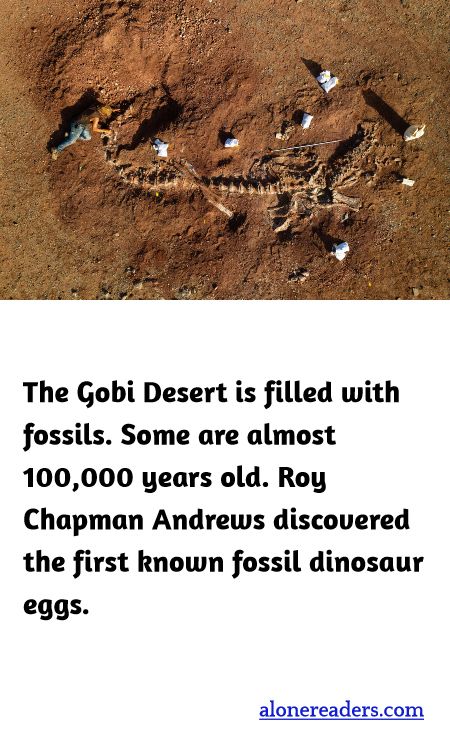
The Gobi Desert, sprawling across China and Mongolia, is not only notable for its harsh, rugged landscapes and the extreme conditions that fluctuate between icy winters and scorching summers but also as a rich repository of paleontological treasures. Among its most fascinating contributions to the field of paleontology are the abundant fossil remains that date back millennia, some being nearly 100,000 years old. These remnants provide significant insights into the prehistoric life that once thrived in this now arid region.
One of the most groundbreaking discoveries in the Gobi Desert was made by the American explorer and paleontologist Roy Chapman Andrews in the early 20th century. Andrews, who led the Central Asiatic Expeditions in the 1920s, is credited with discovering the first-known fossilized dinosaur eggs. This finding was particularly monumental as it provided the first proof that dinosaurs, like many modern reptiles, laid eggs. The discovery was made at the Flaming Cliffs, a region of the desert named for its blazing orange and red sandstone cliffs, which particularly during sunset, appear as if they are on fire. This site has since been identified as one of the richest dinosaur fossil beds in the world.
The significance of these discoveries extends well beyond their initial novelty. Dinosaur eggs, along with other fossils found in the Gobi Desert, have helped scientists piece together important details about the evolutionary history of dinosaurs, including their reproduction, growth, and daily behavior. It has also shed light on the environmental conditions of the era, painting a picture of the shifting climates and geographical transformations over millions of years.
Ongoing explorations and excavations continue to reveal more about the past ecosystems of the Gobi, offering further evidence of the desert’s historical transformation from a region dominated by extensive lakes and lush vegetation to its current stark beauty. Each fossil unearthed not only adds a piece to the puzzle of Earth’s geological and biological history but also serves as a poignant reminder of the constant changes our planet has undergone and continues to experience.
In this context, the Gobi Desert stands as one of the most significant natural archives on Earth, crucial for understanding not only the history of life on our planet but also the processes that have shaped and continue to mold the Earth itself. Each grain of sand and stone in the Gobi holds the potential to unlock stories millions of years old, making it a continuously invaluable resource for scientists and researchers around the globe.
