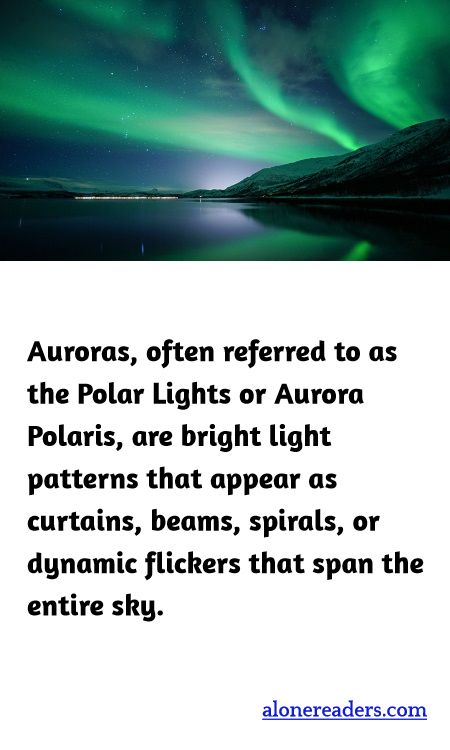
Auroras, captivating natural phenomena also known as the Polar Lights or Aurora Polaris, light up the night skies predominantly near the polar regions with a breathtaking display of vibrant colors. These brilliant displays most commonly appear in hues of green, but they also occasionally show red, yellow, blue, and violet. The phenomena occur when charged particles emitted by the sun, known as the solar wind, collide with the Earth’s magnetic field. This interaction causes particles in the Earth’s atmosphere to become excited, leading to the emission of light.
The process begins with the eruption of solar flares or the ejection of a coronal mass from the sun, which releases a massive stream of charged particles into space. As these particles travel towards Earth, they are funneled toward the poles by the planet’s magnetic field. Upon reaching the upper atmosphere, these solar particles collide with gas molecules such as oxygen and nitrogen. The energy absorbed during these collisions excites the atoms, moving electrons into higher-energy orbits. When the electrons drop back to their original energy levels, they release light, which we perceive as the glowing aurora.
The color of the aurora depends on the type of gas molecule and the altitude at which the interaction occurs. Oxygen, for example, emits a green or a red glow depending on the amount of energy absorbed and the altitude of the collision. Green auroral light, typically seen up to 150 miles in altitude, is produced in lower latitudes, while red auroras are rarer and occur at higher altitudes. Blue and purple lights occur with the involvement of nitrogen molecules under similar energetic conditions but are less frequently observed due to their fainter visibility.
Auroras are predominantly seen in the polar regions because these areas are closest to the Earth's magnetic poles where the magnetosphere is closest to the planet's surface. The Aurora Borealis, or Northern Lights, is visible in the northern hemisphere, while the Aurora Australis, or Southern Lights, can be seen in the southern hemisphere. These lights do not only craft a stunning visual spectacle but also provide valuable scientific information. Researchers study auroras to gain insights into the interaction between solar winds and Earth's magnetic field, which not only influences atmospheric conditions but also affects satellite communications and navigation systems.
While auroras are usually associated with the cold, dark nights in polar regions, during periods of strong solar activity, they can sometimes be seen at lower latitudes. These events create an opportunity for more people around the world to witness this magnificent natural phenomenon, reminding us of the dynamic nature of Earth's relationship with the sun and the vast, beautiful universe beyond.
