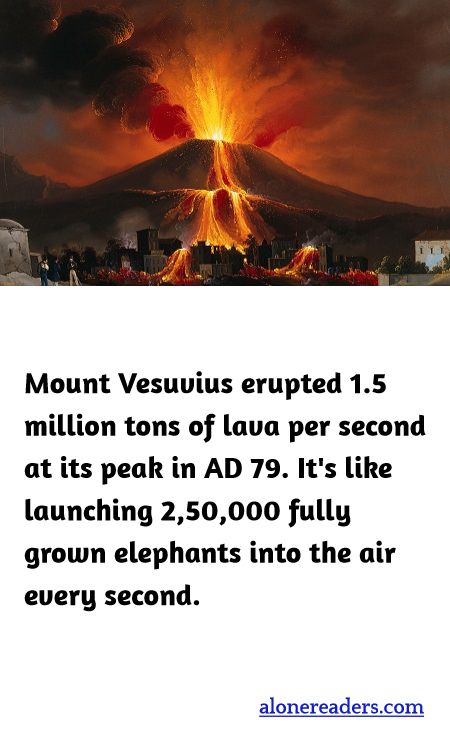
Mount Vesuvius, one of the world's most notorious and active volcanoes, is best known for its catastrophic eruption in AD 79, which led to the burying and destruction of the Roman cities of Pompeii and Herculaneum. This historic eruption is often cited for its sheer magnitude and devastating impact, with the volcano ejecting an astonishing 1.5 million tons of lava per second at its peak. To put that figure into perspective, imagine launching approximately 250,000 fully grown elephants into the air every single second. This comparison not only highlights the scale of the eruption but also helps in visualizing the enormous force and volume of material expelled.
The eruption of Vesuvius in AD 79 was a plinian type eruption, characterized by a continuous column of gas and volcanic material propelled high into the stratosphere, forming a large cloud that could distribute ash across vast distances. The intensity of the eruption was such that it spewed vast amounts of molten rock, ash, and gases at a catastrophic rate, burying the cities and their inhabitants in a thick layer of ash and pumice. Many of the residents were engulfed by the pyroclastic flows—fast-moving currents of hot gas and volcanic matter—that swept through the surrounding areas at speeds of up to 700 km/h and with temperatures reaching 1,000 degrees Celsius.
The aftermath of the eruption preserved the cities in a time capsule, providing invaluable archaeological insights into the daily lives of the ancient Romans. These archaeological sites have been meticulously excavated and studied over the years, offering a glimpse into ancient Roman life, frozen exactly as it was at the moment of the catastrophe. The casts of victims, frozen in time, create a poignant and powerful connection to the human tragedy of the event.
Mount Vesuvius remains an iconic symbol of nature's unpredictable power. Despite its historic eruption thousands of years ago, it is still an active volcano today, constantly monitored by scientists for any signs of activity. Living in the shadow of Vesuvius is a stark reminder of the delicate balance between human settlements and nature's might. The volcano's history, particularly the eruption of AD 79, serves as a crucial study for volcanologists and disaster preparedness experts around the world, emphasizing the need for continued vigilance and respect for our planet's geologic forces.
