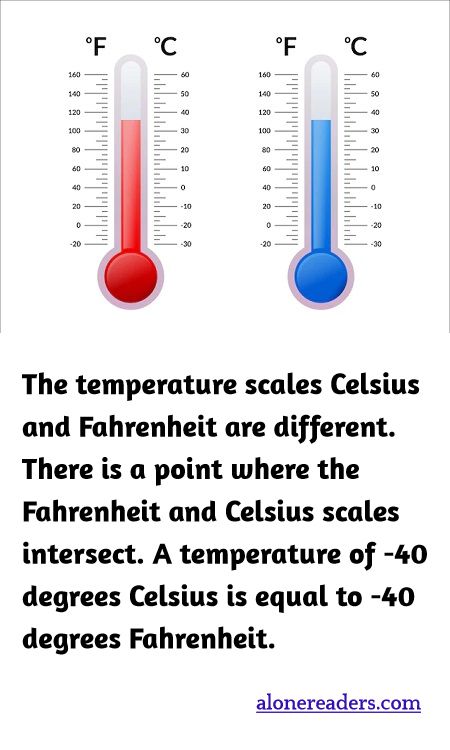
Understanding temperature scales is crucial in weather forecasting, scientific research, and everyday life. The two most common scales are Celsius and Fahrenheit. Celsius, used mainly in most countries worldwide, sets the freezing point of water at 0 degrees and the boiling point at 100 degrees. Fahrenheit, predominantly used in the United States, sets these points at 32 degrees and 212 degrees, respectively.
The conversion formulas between these two systems are essential for scientists, engineers, and even ordinary people who travel or work internationally. The formula to convert Fahrenheit to Celsius is \( C = \frac{5}{9} \times (F - 32) \), and to convert Celsius to Fahrenheit is \( F = \frac{9}{5} \times C + 32 \).
An interesting aspect of these scales is that they intersect at a specific point: -40 degrees. At this temperature, -40 degrees Celsius is precisely equivalent to -40 degrees Fahrenheit. This unique crossover occurs due to the way the scales are configured mathematically. While typically the scales require adjustments to translate one to the other, at -40 they align perfectly.
This convergence has more than just a trivial significance. In extremely cold regions, understanding this equivalence without needing to perform conversions can be quite handy. It also serves as a benchmark for calibration and testing of thermometers and other temperature measuring devices, as at this point, the readings should be the same whether the device measures in Celsius or Fahrenheit.
In essence, the point where Celsius and Fahrenheit intersect represents a rare instance of agreement between two of the most widely used temperature measurement scales in the world. It highlights the interplay between different systems of measurement and the importance of having reliable tools to convert and understand these differences in a globalized world.
