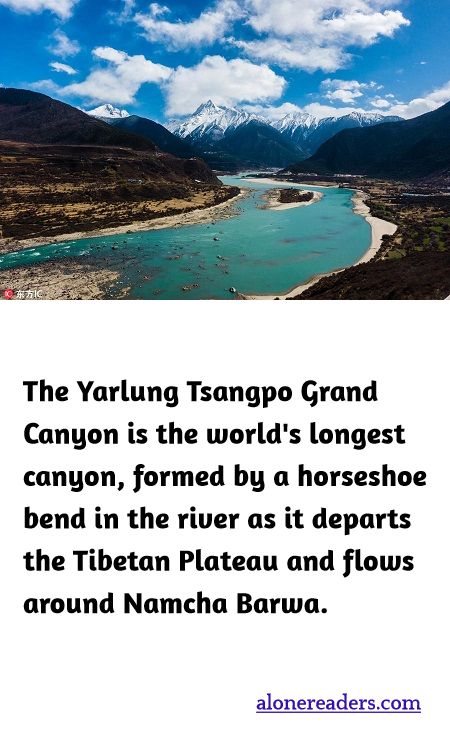
The Yarlung Tsangpo Grand Canyon, recognized as the world’s longest and deepest canyon, is an extraordinary geological phenomenon located in the Tibet Autonomous Region of China. Carved by the relentless force of the Yarlung Tsangpo River, this canyon surpasses others in sheer magnitude and majestic landscapes, including the renowned Grand Canyon in the United States.
The canyon’s origin traces back to the Yarlung Tsangpo River, which is the upper stream of the Brahmaputra River, as it makes a sharp turn around Namcha Barwa, the 28th highest peak in the world. This dramatic bend is responsible for creating the canyon’s unique and extensive topography. The region not only features a remarkable depth—reaching over 6,000 meters at some points—but it also extends approximately 504 kilometers in length. The width of the canyon varies, adding to its complex and rugged nature.
The Yarlung Tsangpo Grand Canyon is not just a natural wonder but also a biodiversity hotspot. The area boasts a unique climate and rich vegetation, ranging from subtropical forests at lower altitudes to alpine meadows at higher elevations. This diverse ecosystem supports a variety of wildlife, including several endangered species such as the leaf deer and the Bengal tiger.
Aside from its ecological importance, the canyon holds significant cultural value for the local indigenous populations, including the Monpa and the Lhoba peoples. The region is steeped in myths and traditions, and many sacred sites can be found scattered throughout the canyon.
Despite its remote location and the challenges associated with navigating its rugged terrain, the Yarlung Tsangpo Grand Canyon attracts adventurers and researchers from around the world. Extreme sports enthusiasts, especially, find the fierce rapids of the river and the challenging trails along its edge irresistible.
Moreover, the canyon plays a crucial role in scientific studies, offering insights into the geological processes that shape the Himalayan region and providing a living laboratory for the study of climate change and its impacts on isolated ecosystems.
In conclusion, the Yarlung Tsangpo Grand Canyon is much more than a natural beauty; it is a vital piece of Earth’s ecological and cultural tapestry. Preserving this treasure will ensure that it continues to tell its ancient stories while contributing to modern scientific knowledge and adventure tourism.
