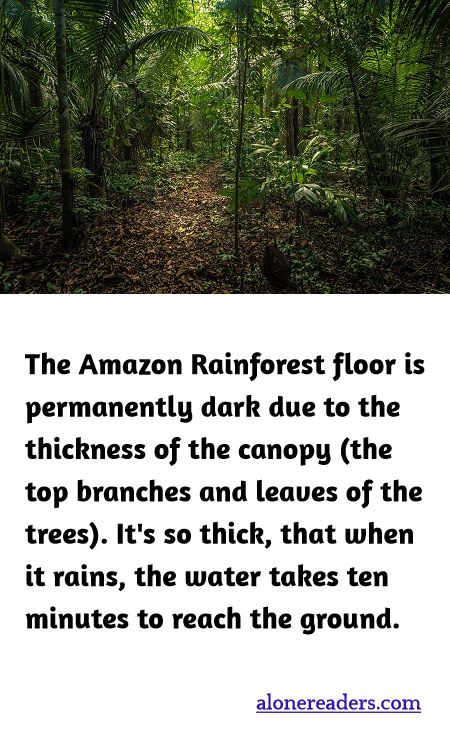
The Amazon Rainforest, often referred to as the "lungs of the Earth," is not only a vital carbon sink but also a fascinating ecosystem with unique characteristics. One of the most striking features of this dense forest is its floor, which is enveloped in near-permanent darkness. This phenomenon can be attributed to the incredibly thick canopy overhead—a lush, intertwining network of branches and foliage that stretches across millions of square miles.
This canopy is so dense that it acts almost like a natural roof over the forest floor. Sunlight struggles to penetrate through the layers of leaves and branches. As a result, only about 1% of the sunlight that hits the top of the forest makes it to the ground. This creates a dim, green-tinted world beneath the canopy, where different rules of survival apply. Under this shadowy cover, plant growth is adapted to low light conditions, and many species have evolved unique mechanisms to capture the scarce rays that filter down.
The thickness of the canopy also affects how rain reaches the forest floor. When it rains, which it frequently does in this tropical region, the water droplets begin a slow descent through the dense foliage above. In fact, it takes approximately ten minutes for rainwater to navigate the canopy and finally drip onto the understory below. This slow trickle of water plays a crucial role in the ecosystem, as it sustains many species of plants and animals that rely on this moisture for survival.
The delayed journey of rainwater has additional ecological benefits. It prevents the force of direct rainfall from eroding the soil and instead allows for a gentle and more evenly distributed hydration of the diverse plant life below. Moreover, this process acts as a natural filtration system, as the water washes over and picks up nutrients from the foliage before reaching the forest floor.
The interactions between the canopy, the understory, and the forest floor are dynamic and vital for the maintenance of the rich biodiversity the Amazon harbors. The characteristics of these layers contribute not only to the complex, self-sustaining nature of the forest but also to its resilience in facing environmental changes. The dense canopy and the shadowy, wet understory together create conditions that foster a wide range of life forms, from large predators to microscopic organisms, each playing a critical role in the forest's ecological networks.
