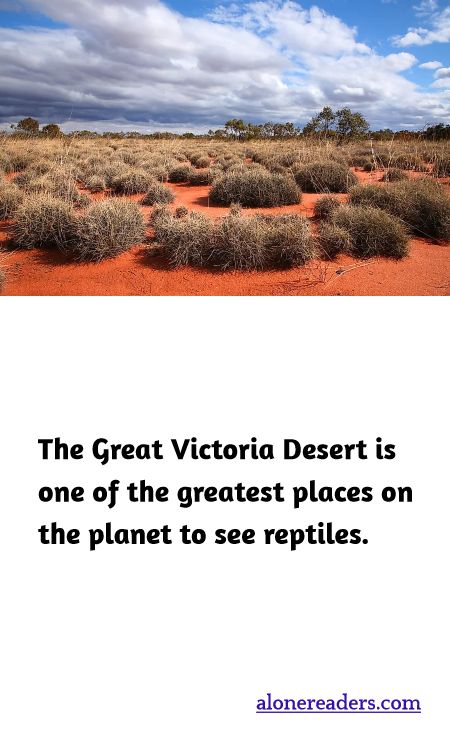
Spanning over 350,000 square kilometers between Western Australia and South Australia, the Great Victoria Desert is an immense and varied landscape. Despite its harsh conditions, with temperatures that can soar to 50 degrees Celsius (122 degrees Fahrenheit), it is home to an unexpected diversity of life, particularly reptiles.
The desert environment, characterized by red sand dunes, rocky outcrops, and sparse vegetation, offers an ideal habitat for numerous reptile species. These creatures have adapted impressively to survive in the arid and extreme conditions of the desert. Among the notable reptiles are the perentie, the largest monitor lizard in Australia, and the thorny devil, famous for its unique method of collecting water through skin condensation.
Reptiles in the Great Victoria Desert have developed fascinating survival strategies. The thorny devil, for instance, features a ridged structure on its skin that helps capture water from dew, allowing it to channel moisture into its mouth, a critical adaptation in such a dry area. Sand-swimming species like the sand goanna and various skinks evade the extreme midday heat and predators by burrowing into cool sand.
The perentie, which can reach up to two and a half meters in length, uses its size and speed to dominate the desert terrain, feeding on a variety of smaller animals and eggs. This predator's presence is crucial to maintaining the ecological balance, controlling the populations of smaller species and scavenging as necessary to clean up the environment.
The diversity extends beyond these larger, more well-known species. The Great Victoria Desert is also home to an array of geckos, dragons, and snakes, each exhibiting their own unique adaptations and behaviors. The woma python, an inhabitant of this region, is an example of a specialized predator, with its ability to inhabit burrows and consume a diet primarily composed of other reptiles.
For enthusiasts and researchers, the Great Victoria Desert offers not just a chance to observe these fascinating creatures in their natural habitat, but also provides valuable insights into their behaviors, adaptations, and roles in the desert ecosystem. Conservation efforts are key to ensuring that this delicate balance is maintained, allowing the desert not only to support its current inhabitants but also to continue serving as a refuge for biodiversity. Thus, this vast Australian desert stands not only as a testament to the resilience of nature but also as a crucial site for biological research and conservation.
