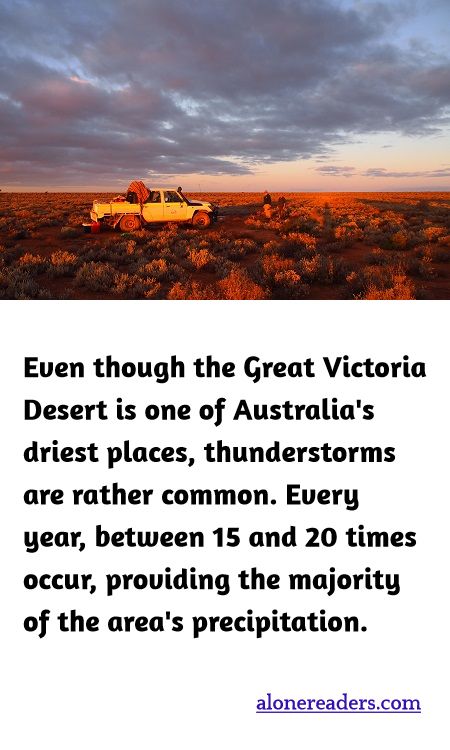
Situated in Australia, the Great Victoria Desert embodies an intriguing confluence of arid desolation and meteorological dynamism. Despite being one of the driest regions in Australia, this vast expanse witnesses a surprisingly frequent number of thunderstorms. Annually, the desert experiences between 15 and 20 thunderstorms, which serve as the primary source of its sparse rainfall.
The mechanics of these desert thunderstorms are fascinating. During the warmer months, the intense heat can cause the air near the ground to become extremely hot and rise rapidly. This air, often carrying moisture evaporated from the sparse vegetation and soil, ascends until it cools and the moisture condenses to form storm clouds. The turbulence induced by the varied desert topography further contributes to the development of these storms. Lightning from these storms is not only a spectacular display but also ignites bushfires that are a natural part of the desert's ecological cycle.
The occurrence of these thunderstorms typically brings about a change in the landscape. Flash flooding can alter the desert surface, carving new channels and depositing nutrients that support a burst of biological activity, including the growth of wildflowers. This ephemeral burst of life attracts various insects, birds, and other wildlife, which capitalize on the brief abundance.
In summary, the Great Victoria Desert exemplifies the complex interplay between climate and landscape, where even one of the driest regions on Earth can host stirring thunderstorms that evoke both destructive and life-giving outcomes. This unique climatic feature not only defines the ecological rhythm of the region but also underscores the diverse and dynamic nature of Australia's desert environments.
