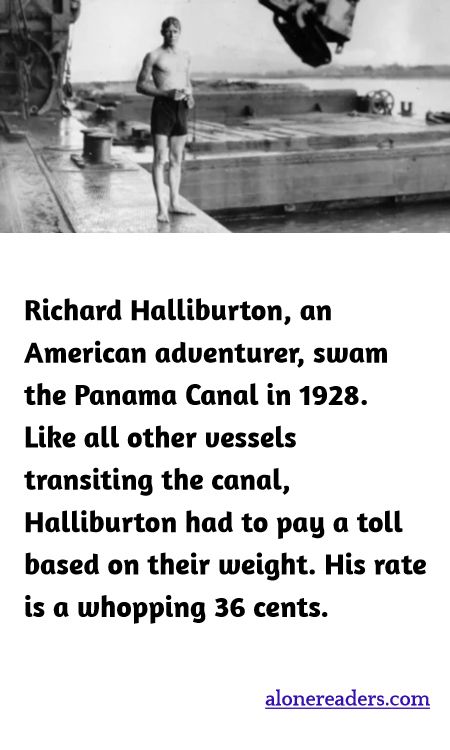
In 1928, the American adventurer Richard Halliburton embarked on a daring and unconventional journey: swimming the Panama Canal. Known for his penchant for dramatic and unusual feats, Halliburton’s swim through the canal was both a testament to his adventurous spirit and a clever stunt that captured the imagination of the public. The Panama Canal, a marvel of engineering completed in 1914, typically served as a passage for freight ships and naval vessels. However, Halliburton transformed it into his personal swimming lane.
The challenge was not only physical but also administrative. Since the canal was an operational maritime route, Halliburton had to officially register as a vessel. Abiding by the rules, he was subjected to the same regulations that applied to any ship passing through. This included paying a toll, which was calculated based on the tonnage of the vessel. In Halliburton's case, his "tonnage" was essentially his own body weight. Strikingly, he was charged a toll of 36 cents, an amount that was both minuscule and symbolic, highlighting the unique nature of his passage.
The swim itself was grueling. Halliburton tackled the 50-mile stretch of the canal, contending with the tropical heat and the complex lock systems that regulated the flow of water. His journey through the canal was closely followed by the media and provided him with ample material for his subsequent lectures and writings. Halliburton's Panama Canal swim was more than just a physical feat; it was a clever promotional act that underlined his flair for blending adventure with a knack for self-publicity.
This swim added to Halliburton's reputation as one of the early 20th century's most colorful and eccentric adventurers. Previously, he had climbed Mount Olympus, flown over Everest, and journeyed through numerous remote regions. Each of these exploits contributed to the image of a man who lived for the thrill of conquest and the allure of the unknown. Through his Panama Canal swim and other exploits, Halliburton inspired many and left an indelible mark on the canon of adventure and exploration literature. His deeds continue to resonate as an example of the lengths to which human curiosity and audacity can go, turning even a utilitarian canal into a stage for remarkable personal achievement.
