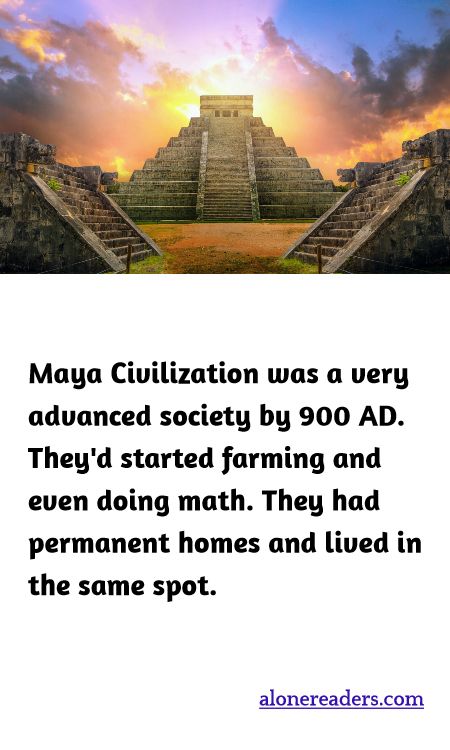
The Maya civilization, which flourished from around 2000 BC to 900 AD in what is now Mexico and Central America, was indeed highly advanced for its time, especially in areas like agriculture, mathematics, and urban planning. By 900 AD, the Maya had not only adopted farming as a staple of their economy but had also developed sophisticated techniques to enhance their agricultural output. They famously employed slash-and-burn methods to clear dense forests and made extensive use of terracing and irrigation to support their crops, which included maize, beans, squashes, and chili peppers.
In mathematics, the Maya were equally innovative. They introduced the concept of zero—a breakthrough at that time and one that would not appear in Europe until centuries later. This was part of their vigesimal (base-20) number system, which they used to develop remarkably accurate astronomical and calendrical systems. Their calendar, consisting of a 260-day ritual cycle and a 365-day civil cycle that mesh into a larger 52-year cycle, allowed them to plan agricultural and ceremonial life with high precision.
Furthermore, Maya cities were marvels of architectural design and urban planning. They built impressive stone cities, such as Tikal, Palenque, and Copán, which featured grand plazas, majestic pyramids, and palaces. These were permanent settlements, indicating a shift from the nomadic lifestyle to a more sedentary, structured society. The urban centers served as hubs for religious, administrative, and trade activities, suggesting a highly organized social structure.
Remarkably, the Maya achieved all this without the use of metal tools, the wheel, or beasts of burden. Their achievements in glyph writing, art, and architecture are attested to by numerous inscriptions and relics that archaeologists continue to study today. The decline of the Maya civilization around 900 AD remains a subject of research and debate among historians and archaeologists. Factors such as overpopulation, environmental degradation, warfare, and prolonged drought are thought to have played roles.
This legacy of the Maya not only shows their ability to adapt and innovate in the face of environmental and social challenges but also serves as a testimony to the resilience and ingenuity of human civilizations in pre-modern times.
