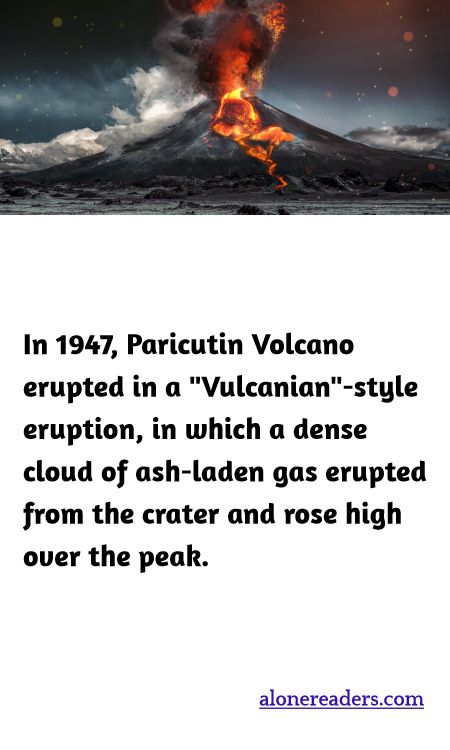
In 1947, the eruption of Paricutin Volcano marked a significant event in the annals of volcanic science. Located in the Mexican state of Michoacán, this volcano erupted suddenly in a cornfield, stunning the local farming community and eventually attracting global scientific interest. This particular eruption is classified as "Vulcanian," a type named after Vulcano, a volcanic island in Italy. Vulcanian eruptions are characterized by a dense cloud of ash-laden gas that is explosively ejected to heights extending far above the summit.
The eruption of Paricutin is notable not only for its intensity but also for its role as one of the first volcanoes to be studied during its entire life cycle, from birth to extinction. Beginning on February 20, 1943, and lasting for about 9 years, its activity offered a unique opportunity for scientists to document the life stages of a volcano. The eruption drastically altered the local landscape. Villages were destroyed, and fields were buried under lava flows and ash deposits, drastically impacting the agriculture upon which the local communities depended.
Interestingly, despite the destruction, there were no direct fatalities attributed to the eruption. This can be attributed to the slow-moving nature of the lava, which allowed for the evacuation of local populations. Furthermore, the Paricutin eruption provided valuable insights into the behavior of volcanic ash clouds, which travel vast distances and affect atmospheric conditions. The ash from the volcano affected climatic conditions in the surrounding areas, and the studies conducted helped in understanding the broader impacts of volcanic ash on global climate patterns.
The 1947 Vulcanian-style eruption of Paricutin remains a significant study subject in volcanology, offering insights not only into the violent and spectacular nature of such eruptions but also into the potential for applied geological science to aid in disaster preparedness and atmospheric studies. Its eruption changed the lives of the local people and altered the landscape forever, but it also contributed extensively to our understanding of geological phenomena.
