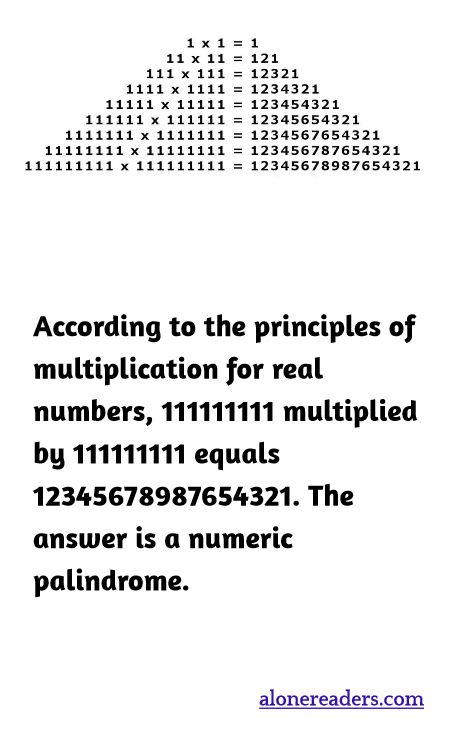
When 111,111,111 is multiplied by itself, the result is 12,345,678,987,654,321. This product is notably a numeric palindrome, meaning it reads the same forwards and backwards. This peculiarity is not just a quirky coincidence but emerges from the underlying pattern formed by the multiplication of these specific numbers.
The number 111,111,111 can be thought of as a repetitive series of the digit 1, appearing nine times. This patterned formation leads, through the multiplication process, to a symmetrical expansion in the form of a palindrome in its product. The entire multiplication process for numbers like 111,111,111 exhibits this pattern, illustrating a basic but profound principle in arithmetic: repetitive numeric sequences often generate palindromic results when squared.
The phenomenon can be extended to other similar numbers consisting of repeated digits. For instance, squaring 1, 11, 111, or 1,111 yields products of 1, 121, 12,321, and 1,234,321, respectively, which are all palindromes. This trend holds due to the way the digits expand outward symmetrically when these specific types of numbers are multiplied by themselves. In base arithmetic, this showcases an interesting property about number bases and their relational outputs in multiplication.
Understanding why such multiplications result in palindromes involves exploring the basics of digit carryover and addition in multiplication. The structure of the numbers - all ones in each place value - results in repeated additions that symmetrical expand, and thus, by the end of the process, collapse back onto themselves in reverse, creating a palindrome.
This striking result is more than a numerical trick; it touches upon the deeper algebraic structures and patterns. For educators and students, this exemplifies the beauty and surprise in elementary mathematics, showing how engaging and intriguing basic concepts can be when explored with curiosity and rigor. Palindromes not only provide a fascinating study in number theory but also inculcate a sense of wonder that can make learning and teaching mathematics more appealing.
