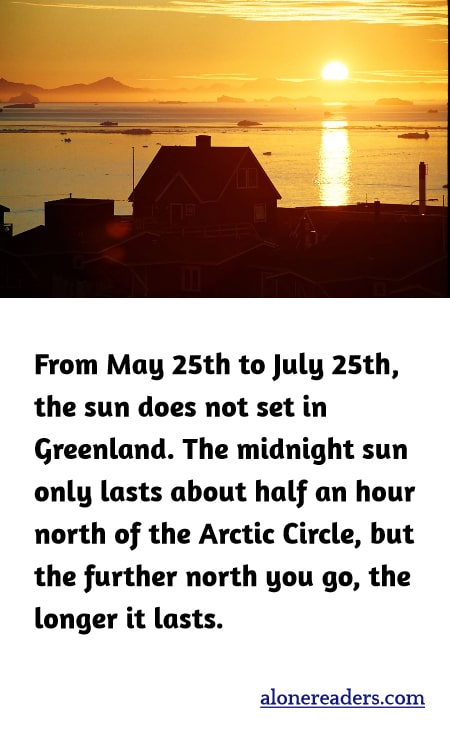
Imagine a place where for two whole months, the sun never sets. Greenland, a vast expanse of stunning Arctic wilderness, offers this rare natural phenomenon called the midnight sun. From May 25th to July 25th, residents and visitors in Greenland experience continuous daylight, a time when the sun hovers above the horizon even at midnight. This unique occurrence happens because Greenland is situated well within the Arctic Circle.
The experience of the midnight sun varies with proximity to the North Pole. While areas just north of the Arctic Circle witness this phenomenon for about thirty minutes, in regions further north the duration extends significantly. For the adventurous souls traveling to the northernmost parts of Greenland, the sun does not dip below the horizon for several weeks, creating a surreal landscape bathed in a permanent golden hue.
This extended daylight affects daily activities, wildlife behavior, and even the mental well-being of people. Locals adjust their lifestyles to make the most out of these sunlit months, engaging in fishing, hunting, and tourism-driven activities late into what would normally be the night. Tourists flock to Greenland during this period for once-in-a-lifetime experiences like wildlife expeditions under the surreal Arctic sky, unforgettable hikes through pristine landscapes, and cultural festivals celebrating the sun’s endurance.
The phenomenon also offers a unique opportunity for photographers and nature enthusiasts to capture the stunning Arctic landscape under constant natural light. The scenery ranges from stark icebergs floating in deep blue waters to vast sheets of ice stretching towards the horizon, all under a sun that refuses to set.
However, as intriguing as it sounds, living under constant daylight can also pose challenges, particularly to those unaccustomed to Arctic summers. Sleep patterns can be disrupted, and the body’s circadian rhythms thrown off balance. Thus, visitors are often advised to prepare themselves for the psychological impact of the midnight sun and to adopt measures to simulate nighttime conditions to ensure restful sleep.
Environmental scientists and climatologists also take interest in this period to study the Arctic’s unique ecosystem and the impacts of prolonged sunlight on glacial melting, wildlife cycles, and local vegetation. As the effects of climate change become more pronounced in polar regions, understanding these patterns becomes crucial.
In essence, Greenland’s midnight sun is not just a stunning natural spectacle but also a way of life, an integral part of the local culture and ecology that offers a broad array of opportunities and challenges. Whether one seeks adventure, solace in nature, or scientific knowledge, the land of the never-setting sun is an unparalleled destination.
