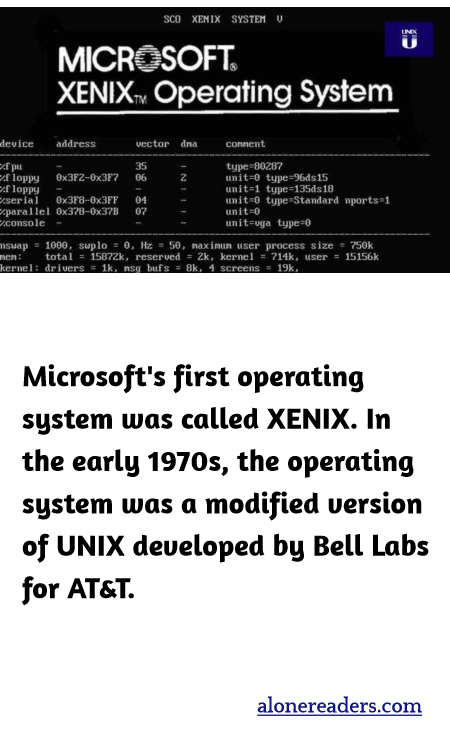
In the landscape of computing history, Microsoft's journey with operating systems began notably with XENIX, which was not originally developed by Microsoft itself, but was instead a derivative of the UNIX operating system. UNIX, developed in the early 1970s by AT&T's Bell Labs, was designed to be portable, multi-tasking and multi-user in a time-sharing configuration. UNIX systems were widely adopted by academic institutions, government bodies, and corporations.
Microsoft entered the scene by licensing UNIX from AT&T in 1979 and started to develop XENIX—its own modified version of UNIX. Although it was largely based on UNIX Version 7, Microsoft made several enhancements to XENIX to support different types of hardware. This move into operating systems by Microsoft was significant, as it marked the company's shift from focusing solely on software tools, such as programming language interpreters, to a broader scope including foundational software that would run computers.
XENIX was initially targeted at various small to medium-sized businesses for use in administrative tasks, data processing, and as an environment for developing system software. Microsoft did not, however, market XENIX directly to end users. Instead, it licensed the system to hardware OEMs like Tandy, SCO, and Altos, which then bundled it with their own computers. This indirect method helped Microsoft expand its reach in the operating system market without building its own computer systems, which permitted a focus on software development.
Despite the initial success and adoption of XENIX in various sectors, Microsoft eventually moved away from it as part of a broader strategy shift towards developing a graphical user interface-based OS, which led to the development of Windows. Internally, Microsoft transitioned to using MS-DOS (a system whose original development was also outsourced, based on QDOS), which later became the basis for early versions of Windows. Although XENIX was gradually phased out, its existence played a critical role in the early stages of IT evolution by providing an alternative to UNIX that was suitable for various commercial and industrial applications.
In summary, XENIX played a foundational role in Microsoft's evolution as a company deeply involved with operating systems. It allowed Microsoft to gain essential experience which would later inform the development of its more famous OS offerings and helped in setting the stage for the dominance of personal computers in both homes and workplaces globally.
