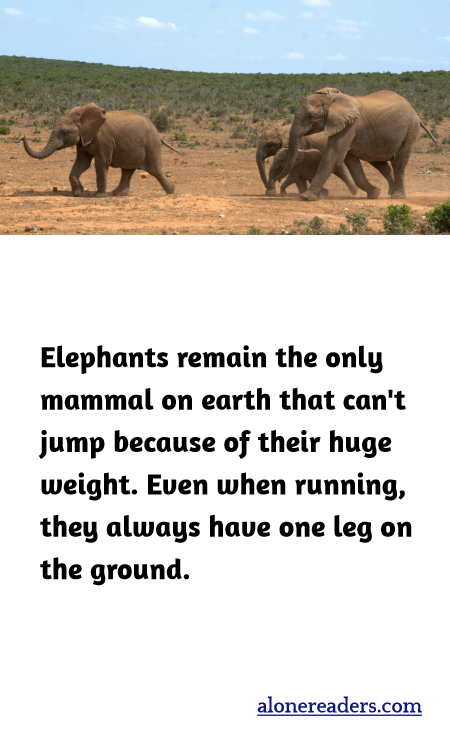
Elephants, majestic and massive, hold a unique distinction among mammals—they are the only ones incapable of jumping. This limitation arises primarily due to their enormous size and weight. An adult elephant can weigh between 2,000 to 6,000 kilograms, depending on the species, making the act of leaping from the ground physically unfeasible.
The elephant's skeletal and muscular structures also contribute to this inability. Their legs are designed more for strength than for the accumulation of the kinetic energy needed for jumping. While other animals have more elastic muscle fibers that can store and release energy quickly, an elephant's fibers are stiffer and more suited to supporting their vast weight. This design ensures stability and endurance, rather than speed or agility.
Interestingly, even when elephants run—which they can do at speeds up to 25 miles per hour—they keep at least one foot on the ground at all times. This movement pattern is known as the rotary gallop, as opposed to the bounding gallop seen in smaller mammals where all four feet can leave the ground simultaneously. By always maintaining contact with the earth, elephants stabilize their heavy bodies and prevent injury that could occur from the impact of landing.
This inability to jump, however, does not hinder elephants from navigating their environments effectively. They possess great strength and can push down or step over obstacles blocking their path. Their trunks and tusks are also useful tools in manipulating the environment to meet their needs. Moreover, elephants are proficient swimmers and use waterways as pathways to travel, feed, and cool down, thus bypassing many terrestrial challenges.
Despite this limitation, elephants have thrived for millions of years across various ecosystems in Africa and Asia. Their evolution has perfectly adapted them to their roles as ecosystem engineers, shaping the landscapes through feeding, watering, and movement habits. Thus, while they may be earthbound in one physical aspect, they overwhelmingly transcend this through their significant impact on their habitats and the biodiversity that depends on them.
