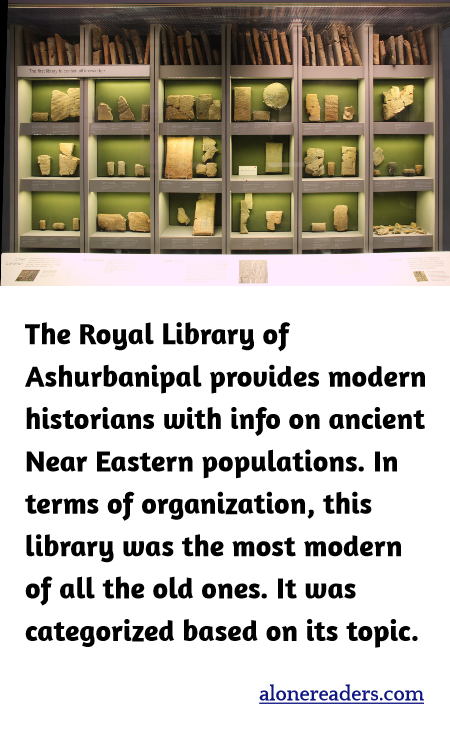
The Royal Library of Ashurbanipal, named after King Ashurbanipal who ruled the Neo-Assyrian Empire from 668 to 627 BCE, remains one of the greatest archaeological discoveries relevant for understanding ancient Near Eastern civilizations. Considered the earliest systematically organized library known to history, it significantly juxtaposes modern archival strategies with ancient innovations. The library was discovered in the ruins of Nineveh, modern-day Mosul, Iraq, and has been instrumental in providing a voluminous insight into the life, laws, literature, and beliefs of various ancient Near Eastern populations.
What sets the Royal Library of Ashurbanipal apart is its remarkable organizational method, which indeed makes it appear strikingly 'modern.' Each of the texts was meticulously categorized according to subject matter, ranging from religion, magic, and mythology to science, government, and even poetry. This classification facilitated easier management and retrieval of information, much like modern libraries. Among its most famous holdings is the epic poem "Gilgamesh," which is considered one of the earliest great works of literature. Additionally, the library contained numerous texts written on clay tablets in the Akkadian language using cuneiform script, providing a wealth of information that includes economic transactions, legal decisions, and medical treatments.
This ancient library not only underscores the intellectual rigor of Ashurbanipal, who was possibly the first king to assemble texts from various conquered territories, but also reflects a wider intellectual culture that valued knowledge and scholarship. The systematic approach to knowledge management seen in Ashurbanipal’s library can be compared to modern digital cataloging methods involving metadata and categorization—principles that underpin current informational organization and retrieval systems.
Furthermore, this ancient library has played a pivotal role in allowing modern historians to reconstruct the events, daily life, and thought processes of Mesopotamian civilizations and other ancient Near Eastern peoples. Through comparative studies of texts from the library, researchers have been able to gain insights into regional interactions, cultural exchange, and historical conflicts. The legacy of the Royal Library of Ashurbanipal extends its utility beyond mere historical curiosity, providing foundational texts that continue to inform scholarly studies in linguistics, mythology, history, and even philosophy.
The advanced organizational structure of the Royal Library of Ashurbanipal undoubtedly set a precedent in library science, evidencing an early understanding of the importance of accessible information. This ancient establishment not only mirrors the sophistication of the Assyrian empire but also its forward-thinking approach in preserving and celebrating knowledge.
