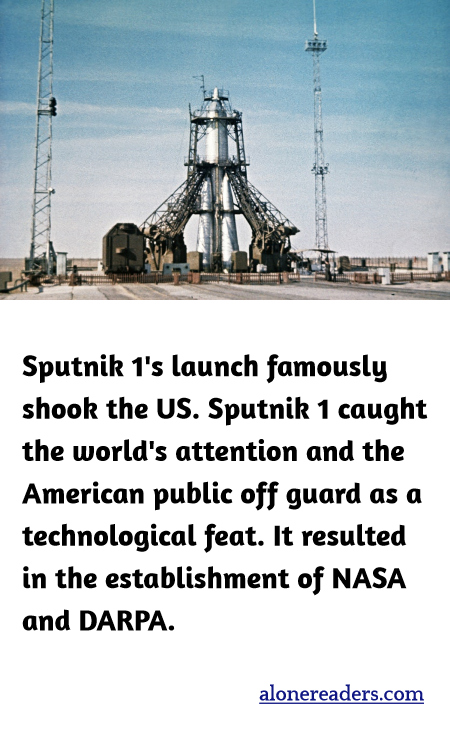
On October 4, 1957, the Soviet Union successfully launched Sputnik 1, the world's first artificial satellite, into orbit around the Earth. This epochal event not only marked the beginning of space exploration but also had profound implications for the global balance of power during the Cold War. The successful launch of Sputnik 1 came as a surprise to the international community and particularly shocked the United States, which had been leading in many technological arenas.
The impact of Sputnik 1 went far beyond its scientific achievements. In the United States, it catalyzed a wave of anxiety known as the "Sputnik crisis." Americans were stunned that the Soviet Union had taken the lead in space technology, which was seen as a critical component of military power. This led to a fear that the U.S. was falling behind the Soviet Union in technology and innovation, which had significant implications for national security.
In response to the perceived threat from the Soviet Union’s advances, the U.S. government took immediate and decisive action to reclaim its position as a leader in science and technology. This involved massive investments in science education through the National Defense Education Act, which aimed to produce more engineers and scientists. Additionally, the launch of Sputnik directly led to the creation of two pivotal institutions: the National Aeronautics and Space Administration (NASA) in 1958, and the Defense Advanced Research Projects Agency (DARPA) that same year.
NASA was established as a civilian agency to oversee all non-military space activity, aiming to ensure American leadership in space sciences. Its creation signaled a significant realignment of resources and priorities towards space exploration, marking the start of the U.S. space program's most dynamic era. With aggressive missions and developments, NASA not only aimed at exploring space but also sought to foster international prestige and demonstrate technological superiority over the Soviet Union.
DARPA’s formation, on the other hand, was aimed at ensuring that the United States stayed ahead of its adversaries in terms of technological advancements, particularly in areas critical to national security. As an institution, DARPA focused on developing emerging technologies for use by the military, ensuring that the U.S. military had the upper hand in future conflicts.
The launch of Sputnik 1 thus had a lasting impact on U.S. science, technology, and military policies. It triggered a series of events that underscored the significance of maintaining technological superiority in a rapidly changing world. The space race that followed not only transformed the landscape of international competition but also pushed the boundaries of human knowledge and capabilities in space exploration.
