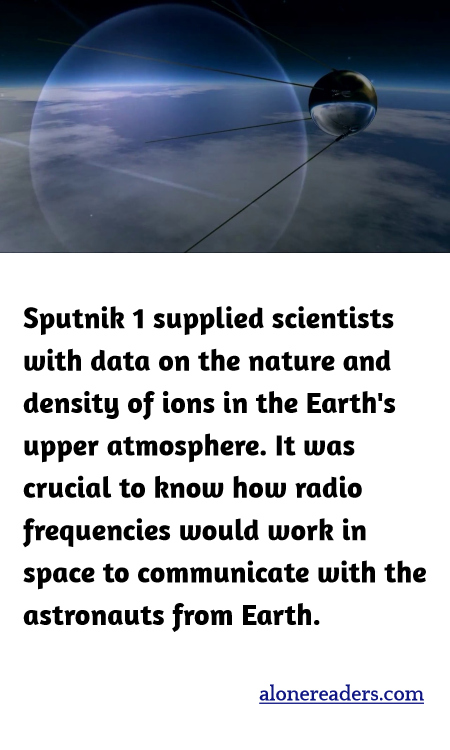
On October 4, 1957, the launch of Sputnik 1 marked a historic moment as the first artificial satellite to orbit the Earth. This remarkable achievement by the Soviet Union not only kicked off the space age but also played a pivotal role in advancing our understanding of the upper atmosphere and space. Sputnik 1, though seemingly modest in design, was equipped with four external radio antennas to broadcast radio pulses, which were crucial for it to communicate with the ground stations on Earth. These signals were vital not only for the tracking of the satellite but also for collecting data on the satellite's environment.
As Sputnik 1 orbited Earth, it passed through various layers of the atmosphere at different altitudes. The data sent back was instrumental in studying the ionosphere, a layer of Earth's atmosphere that is ionized by solar and cosmic radiation. Scientists were particularly keen on measuring the density and composition of the ions in this layer because of its influence on radio wave propagation, which is crucial for space-to-Earth communication systems. Understanding the ionosphere was essential for improving long-distance radio communications and for developing future technologies to aid space exploration.
The signals from Sputnik 1 allowed scientists to analyze how radio waves behaved in the ionosphere, including how they were affected by the charged particles found there. This was critical for enhancing the reliability and effectiveness of space communication technologies. Prior to this, knowledge about the ionosphere was relatively vague and mostly theoretical. The practical insights gained from Sputnik's journey provided the empirical data needed to refine existing models of atmospheric ion distribution.
Moreover, the success of Sputnik 1 significantly fueled the space race between the United States and the Soviet Union, spurring further technological and scientific research. This led to more sophisticated satellites and missions that could delve deeper into the mysteries of space and our planet's atmosphere. Ultimately, the mission of Sputnik 1 exemplifies how a single scientific endeavor can have far-reaching effects on technology and knowledge, paving the path for future explorations and discoveries in space science and communication technologies. The data it provided illuminated our understanding of Earth's upper atmosphere, influencing not just space research but all technologies reliant on radio wave transmissions.
