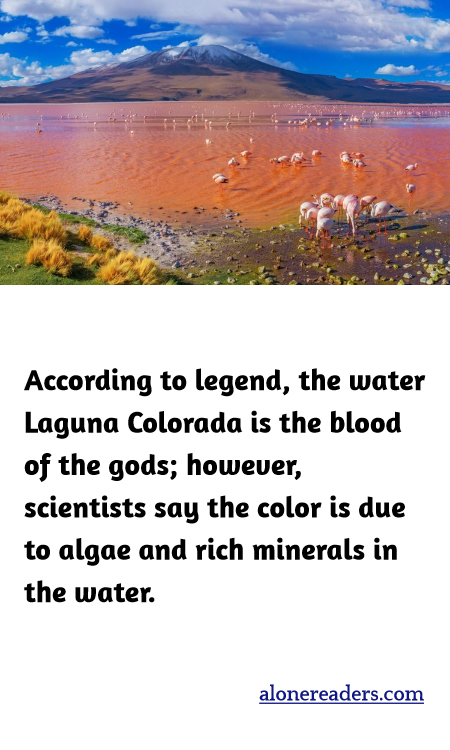
Nestled high in the Bolivian Andes, Laguna Colorada is a striking sight that seems to meld the otherworldly with the mythical. This shallow salt lake, famous for its vibrant red color, spans approximately 60 square kilometers. The local legends capture the imagination, speaking of the lake's waters as being tinted with the blood of gods, offering a narrative steeped in mystery and reverence.
In contrast to these mystical tales, scientific explanations provide a clearer understanding of the lake's unique hue. The red coloring of Laguna Colorada can be attributed to pigmented algae and other microorganisms that thrive in its mineral-rich waters. These organisms, particularly the algae that produce carotenoids, imbue the lake with its distinctive crimson and orange shades. Additionally, the presence of sediments and the high concentration of minerals like borax and gypsum, known for their reflective properties, contribute to the lake's vivid appearance.
The stark contrast between myth and science at Laguna Colorada is a fascinating aspect of human interaction with natural wonders. Local stories and spiritual interpretations of the landscape are a reflection of the cultural importance of the lake to indigenous communities. These tales not only enrich the mystique of the place but also highlight the deep connection between people and their environment, passed through generations.
Meanwhile, the scientific insights allow us to appreciate the ecological and biological significance of such sites, promoting a broader understanding and fostering a commitment to preserving these natural habitats. The interplay of unusual ecological conditions and the resultant biodiversity, including flocks of Andean flamingos that often dot the lake, painting a surreal picture, underscores the ecological value of Laguna Colorada.
Thus, whether one is drawn to its shores by the allure of ancient myths or the pursuit of scientific exploration, Laguna Colorada remains a symbol of the natural beauty and complexity of our planet. It stands as a reminder of how folklore can coexist with scientific knowledge, each providing different ways to value and marvel at the natural world.
