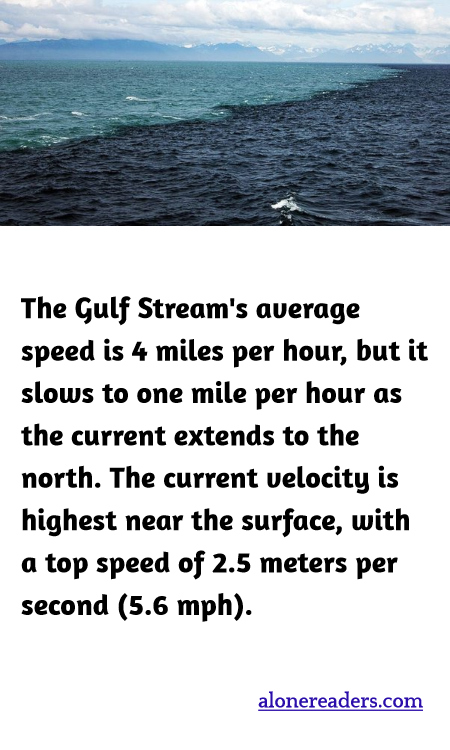
The Gulf Stream, a powerful Atlantic Ocean current originating at the tip of Florida and extending up the eastern coastlines of the United States and Newfoundland before crossing the Atlantic Ocean, is renowned for its significant influence on the climate and navigation. On average, the Gulf stream moves at a speed of about 4 miles per hour, but as it extends northward, its speed decreases to about 1 mile per hour. This deceleration is primarily due to the widening of the current and the complex interaction with other water masses and ambient environmental conditions.
The fastest currents within the Gulf Stream are observed near the surface, where speeds can reach up to 2.5 meters per second, equivalent to about 5.6 miles per hour. These higher velocities are typically found in the core of the stream where the water is warmer and saltier, contributing to a higher water column stability and faster flow. The speed gradually diminishes at greater depths, influenced by frictional drag against the continental shelf and the influx of colder waters from the deeper ocean.
This vibrant oceanic river is critical not just for marine navigation, aiding ships crossing from the Americas to Europe, but also plays a pivotal role in moderating the climate of the regions it touches. By transporting warm Caribbean waters northward, it helps to keep the climates of northwestern Europe significantly warmer than other regions at similar latitudes. Moreover, the Gulf Stream's interactions with the atmosphere affect weather patterns across the North Atlantic, influencing everything from hurricane trajectories to rainfall distributions. Thus, understanding its patterns and behaviors is crucial for meteorology, oceanography, and climate science.
