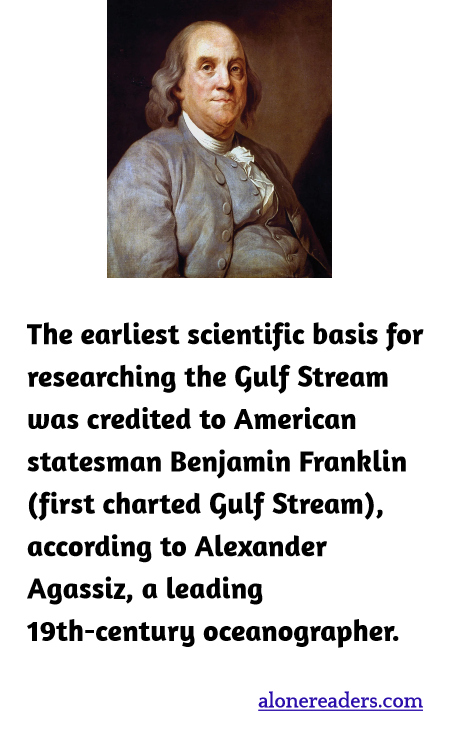
The exploration and understanding of the Gulf Stream, a powerful, warm Atlantic Ocean current, have significantly evolved since its initial study by one of America’s founding fathers, Benjamin Franklin. Franklin’s curiosity about the natural world was not limited to his famous electrical experiments; it also extended into the marine environment, particularly the Atlantic Ocean currents that considerably impacted transatlantic shipping and navigation.
In the mid-18th century, Franklin was working as postmaster general of the American colonies when he heard from colonial ship captains of a strong ocean current that seemed to disrupt the mail packet service between North America and England. Intrigued by these accounts, Franklin began a meticulous investigation, gathering data from ship logs and collaborating with his cousin, Timothy Folger, a skilled mariner familiar with whaling paths that coincidentally charted a course through this current.
Through their collective effort, Franklin and Folger charted the Gulf Stream for the first time, outlining its path and highlighting its velocity and temperature differences compared to surrounding ocean waters. Franklin's pioneering chart was published in 1770, offering an initial scientific glimpse into the stream's nature and its implications for navigation and oceanography.
His work marked the beginning of the scientific approach to studying ocean currents, marrying practical navigation concerns with broader scientific inquiry. Franklin’s insights into the Gulf Stream were later expanded upon by 19th-century oceanographer Alexander Agassiz. As marine science progressed, Agassiz recognized the foundational role Franklin's observations played in the broader study of marine currents. In terms of laying the groundwork for systematic and scientific oceanographic studies, Franklin’s initial charting of the Gulf Stream was an indispensable contribution, bridging early maritime knowledge and modern oceanography.
Through these cumulative efforts, our understanding of the Gulf Stream has expanded, now acknowledging its critical role in regulating climate, supporting marine ecosystems, and influencing weather patterns across the Atlantic. Franklin's legacy in oceanography illustrates how curiosity and interdisciplinary research can lead to foundational knowledge pivotal in further scientific advancements. Indeed, from charting an ocean current in the 18th century to modern climate science, the exploration of the Gulf Stream encapsulates the evolution of scientific inquiry and its enduring impact.
