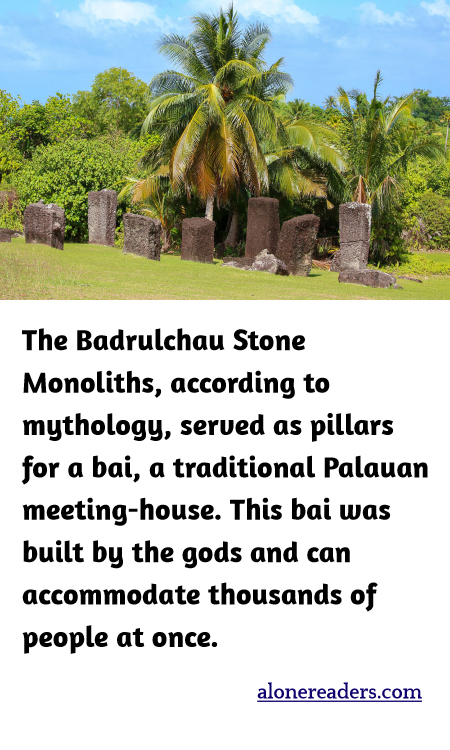
In the heart of Palau, an intriguing and mystic site known as the Badrulchau Stone Monoliths captivates both the minds of historians and the imagination of those versed in local folklore. Located on the island of Babeldaob, the largest in the archipelago, these ancient relics consist of 37 basalt monoliths arranged on a raised terrace. Some of these impressive stones weigh over 5,000 kilograms and their origins and purposes continue to be subjects of both academic research and cultural intrigue.
According to Palauan mythology, these stones are not merely geological formations or arbitrary placements by past human hands; they are said to be the pillars of an enormous bai, a traditional Palauan meeting house. This was no ordinary bai but one constructed by the gods themselves, capable of accommodating thousands of individuals simultaneously. It was purportedly a center for communal gatherings, discussions, and rituals, embodying the cultural and social sphere of ancient Palauan society.
This legendary bai would have been a structure of monumental scale and significance, symbolizing unity and strength among the people. The idea of it mirrors the social and political role played by traditional bais in the daily life of Palauan communities, where leaders met, decisions were made, and communities bonded through shared customs and narratives.
However, despite these captivating tales, no concrete evidence of the superstructure mentioned in the myths has been found so far. The monoliths today are seen primarily in their serene setting, surrounded by grass and trees, standing as silent witnesses to a past that blends history with myth. The site not only offers a glimpse into the prehistoric past of Palau with its enigmatic huge stone formations but also continues to be a significant cultural landmark.
Archaeological studies suggest that the area surrounding Badrulchau had been inhabited as early as 161 AD. However, the precise age and the original purpose of the stones remain uncertain. Some theories propose that the site might have served astronomical functions or been used in religious ceremonies.
The blend of historical ambiguity and mythological grandeur makes the Badrulchau Stone Monoliths a fascinating subject for both scholars and tourists. They encapsulate a profound cultural memory and mythos of a people deeply connected with their environment and the divine. As research continues and more discoveries are made, perhaps the line between myth and history at this ancient site will become clearer, offering deeper insights into the rich heritage of Palau.
