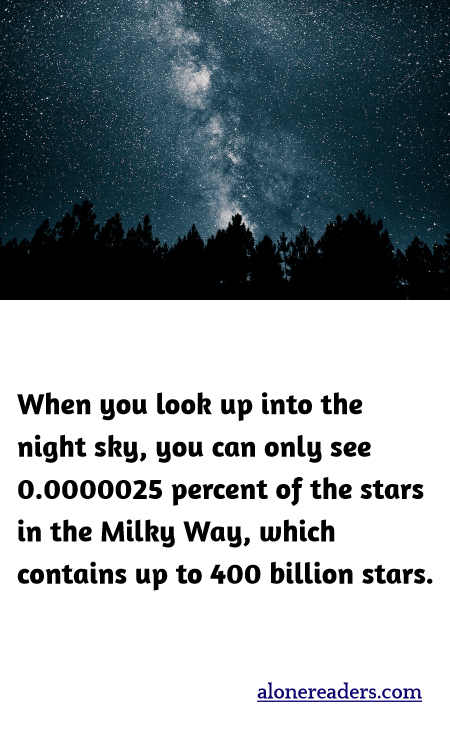
Gazing into the night sky is one of the most ancient and universal of human experiences, filled with mystery, contemplation, and grandeur. Despite its familiarity and sheer vastness, what we see with the naked eye from Earth is but a minuscule fraction of what actually exists in our galaxy. Out of an estimated 400 billion stars in the Milky Way, we can only see about 0.0000025 percent of them without the aid of telescopes.
This tiny percentage represents primarily the stars that are nearest and brightest, but even many of these are obscured by atmospheric conditions, light pollution from cities, and the limited sensitivity of the human eye. Most of the stars in the galaxy are spread far across its sprawling arms and dense core, much beyond the reach of casual observation from Earth.
The sheer scale of these numbers is difficult to comprehend. To visualize it: for every star visible to the naked eye, there are millions more that go unseen. These unseen stars include not only distant suns but also entire solar systems that might harbor exotic planets and unknown phenomena.
The invention of the telescope dramatically increased our capacity to observe and understand the cosmos, revealing not just faint stars but also planets, nebulae, galaxies, and more. Modern astronomy, equipped with technology like the Hubble Space Telescope and the upcoming James Webb Space Telescope, continues to expand our cosmic horizon. Through these instruments, astronomers can capture light that has traveled for billions of years and peer back in time to the early stages of the universe.
Despite our technological advancements, the basic experience of looking up at the stars remains primarily unchanged, a bridge connecting us not just to the ancient cultures that did the same, but also to the broader universe itself. Each star we observe serves as a reminder of the immense scale of our galaxy and how much remains unknown, prompting both humility and curiosity. This wondrous pursuit not only enriches our understanding of the cosmos but also deepens our connection to the mysterious, beautiful expanse of the night sky.
