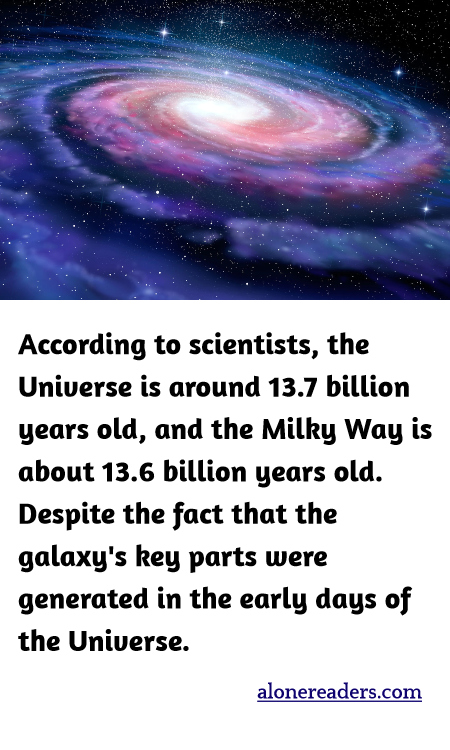
The age of the Universe and the Milky Way galaxy are profound indicators of the immense scale and complex history of cosmic evolution. The Universe, estimated to be about 13.7 billion years old, began with the Big Bang, an enormous explosion that set the foundation for everything that exists today. Following closely behind in age is the Milky Way galaxy, our cosmic home, which is believed to be around 13.6 billion years old.
The formation of the Milky Way galaxy is a testament to the processes that dominated the early Universe. In its infancy, the Universe was a hot, dense place, filled with a uniform glow from the Big Bang. As it expanded and cooled, variations in density began to form, eventually leading to the condensation of gas and dust into the first stars and galaxies.
The Milky Way itself likely started as a series of small proto-galaxies that gradually merged through gravitational attraction. This accretion process is critical in galactic formation and was particularly active in the early Universe. The Milky Way, like other galaxies formed during this era, underwent dramatic changes and growth spurts as it absorbed numerous smaller celestial systems.
One of the core components of the Milky Way is its central bulge, which contains a high concentration of older stars. This dense, elliptical structure suggests that significant star formation activity took place in the early stages of the galaxy’s life. Essentially, the bulge indicates that the central region of the Milky Way was one of the primary locations for the creation of new stars, thereby playing a crucial role in the galaxy’s early development.
In the grand panorama of the Universe, the almost simultaneous appearance of the Milky Way shortly after the Big Bang highlights the interconnected nature of cosmic events. The initial conditions set by the Big Bang were instrumental in shaping the structure and composition of early galaxies like the Milky Way. It also points to the incredible speed with which matter began to organize itself under the influence of gravity, leading to increasingly complex structures.
Understanding the age and early formation of the Milky Way not only provides insights into the history of our own galaxy but also serves as a pivotal piece in the broader puzzle of the Universe’s history. Each discovery in this field helps astronomers and cosmologists piece together the timeline and processes that have shaped everything from the smallest planets to the largest galaxies. This ongoing exploration of our origins continues to challenge and expand our understanding of the cosmos.
