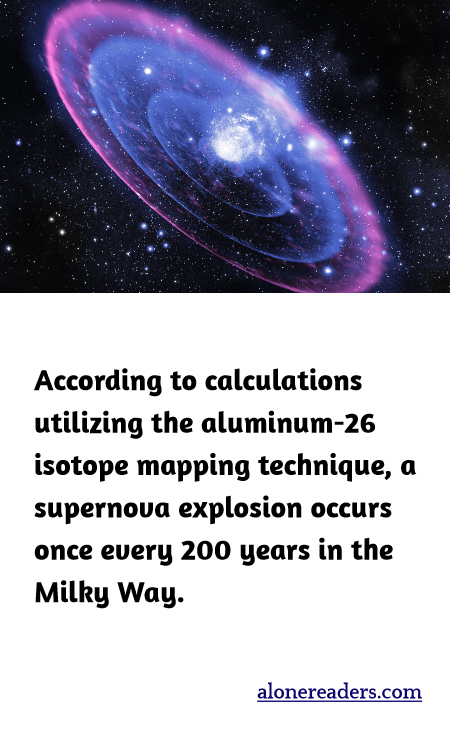
The vast expanse of the Milky Way teems with stellar activity, including the spectacular and violent events known as supernovae. These cataclysmic explosions mark the death throes of massive stars and play a critical role in the cosmos by enriching the interstellar medium with heavy elements and triggering the formation of new stars. Recent studies employing aluminum-26 isotope mapping have shed new light on the frequency of these stellar explosions. According to this innovative approach, it is estimated that a supernova explosion occurs approximately once every 200 years within our galaxy.
Aluminum-26, a radioactive isotope, serves as a vital tool in understanding supernovae. It is produced during the nuclear fusion that occurs in the heart of a massive star, and later expelled into space when the star explodes. By tracking the presence and distribution of this isotope across the galaxy, scientists can map past supernova events and estimate their frequency. This isotope's half-life of about 720,000 years allows researchers to look back across thousands to millions of years of galactic history.
These findings alter not only our understanding of how often supernovae occur but also influence theories regarding the evolution of the Milky Way and the very distribution of elements that are essential for the formation of planets and life. Each supernova has the potential to distribute vast amounts of material across wide swaths of space, including elements like iron, carbon, and other heavy elements critical for life as we know it.
The revelation that supernovae occur once every 200 years suggests a dynamic and continually evolving galactic environment, within which the seeds of new stars and possibly even planetary systems, are regularly sown. This relatively frequent rate of explosions also highlights the significant role supernovae have in shaping the structure and chemical abundance patterns observed within the Milky Way.
As astronomers continue to refine the techniques used to map and understand these explosive events, our picture of the universe becomes ever more detailed. These insights not only push the boundaries of our knowledge about the universe but also bring us closer to piecing together the cosmic puzzle of how galaxies, stars, and ultimately life itself, emerge from the chaos of space.
