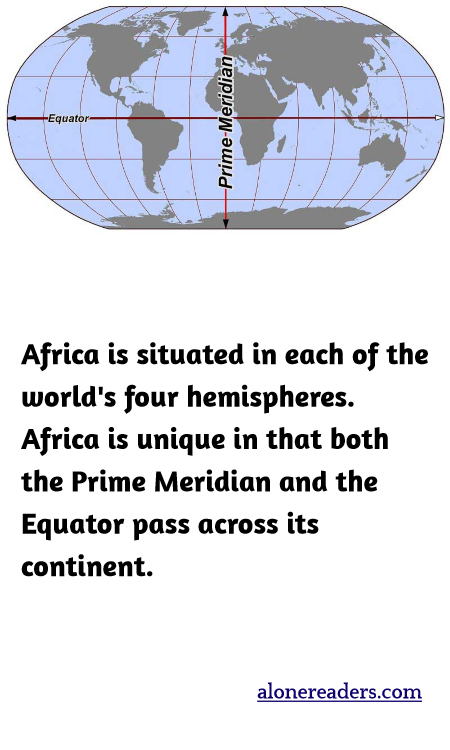
Africa's geographical positioning is quite remarkable, spanning the eastern, western, northern, and southern hemispheres. This sprawling continent uniquely straddles both the Prime Meridian and the Equator, making it the only continent in the world to be intersected by both of these significant lines. The Equator divides Africa into almost two equal halves, creating diverse climates and ecosystems ranging from tropical rainforests near the central equator to arid deserts in the north and lush temperate regions in the south. This division provides a wide range of biodiversity, which includes some of the most unique wildlife and plant species on the planet.
The crossing of the Prime Meridian, on the other hand, influences Africa's time zones and has historical significance in terms of colonial and global mapping practices. The Prime Meridian running through countries like Ghana and Algeria has played a significant role in their history, particularly in the context of global positioning and navigation. The presence of both the Equator and the Prime Meridian also highlights Africa’s central role in global geostrategic and geopolitical discussions, emphasizing its physical and symbolic position in the world.
Additionally, Africa's place on the globe influences its weather patterns, seasonal variations, and even the health issues that are prevalent in different parts of the continent. For instance, countries lying on or close to the Equator experience intense sun exposure, contributing to climatic conditions conducive to diseases like malaria. Meanwhile, the varied exposure to sunlight across the continent results in a wide range of agricultural practices and crop cultivation, pivotal to the economies of African countries.
The fact that Africa is the only continent pierced by both the Prime Meridian and the Equator is not just a geographical trivia but is reflective of its central role in discussions about global history, culture, and environmental studies. It is a continent with a vast expanse covering approximately 30.3 million square kilometers, housing over 1.3 billion people who speak up to 2000 different languages. This intersection symbolizes the blending and coexistence of diverse cultures and communities, contributing to the rich history and heritage of the continent. The convergence of these significant geographical markers underscores Africa's pivotal place on the global map, enhancing its status as a continent rich in resources, cultural diversity, and historical significance.
