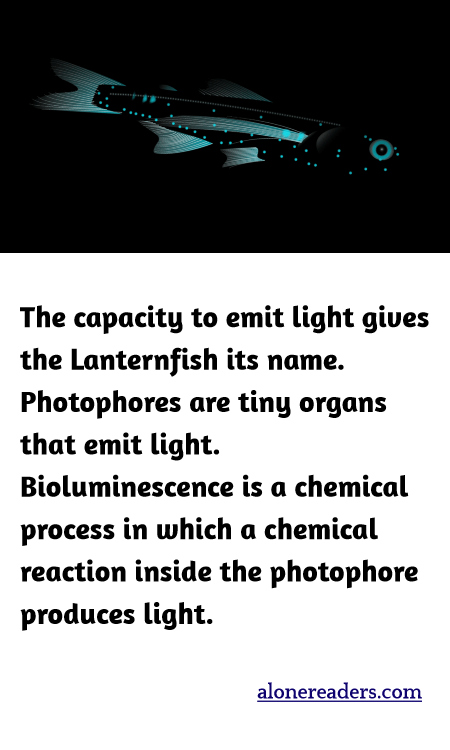
The lanternfish, named for its unique ability to emit light, is one of the most fascinating creatures of the deep sea. This ability, known as bioluminescence, originates from specialized organs known as photophores, which are distributed across the fish's body. These tiny organs produce light through a chemical process that involves the reaction of organic molecules, primarily luciferin, in the presence of oxygen and the enzyme luciferase. The light produced by these reactions can vary in intensity and even in color, depending on the species of lanternfish and the specific chemicals involved.
Bioluminescence serves several vital functions in the dark depths of the oceans, where sunlight is unable to penetrate. For many lanternfish, the primary use of their light-emitting ability is for camouflage. The light helps them match the faint sunlight from above, thereby masking their silhouette and protecting them from predators lurking below. This technique, known as counterillumination, involves the photophores emitting light to mimic the ocean surface as seen from below, making the fish nearly invisible against the faint light filtering down from the surface.
Aside from camouflage, lanternfish also use bioluminescence for attracting prey and for communication. The specific patterns and pulses of light can signal different messages, from warning signals to potential mates. This form of communication is crucial in the immense and dark ocean depths, where visual signals are one of the few ways to communicate over larger distances.
Moreover, lanternfish play a significant role in marine ecosystems, particularly in the phenomenon known as the "deep-sea scattering layer." Each night, vast numbers of lanternfish migrate up to the upper layers of the ocean. This migration is so massive that it can be detected by sonar, appearing as a false seabed. During the day, they return to the depths, helping to transport nutrients and energy within the ocean, and serving as a crucial food source for a variety of larger predators.
Understanding lanternfish and their bioluminescent capabilities illuminates the complex interactions within marine ecosystems and highlights the fascinating adaptations of deep-sea life. Their study not only helps in grasping the biological functions of creatures living in one of the most extreme environments on Earth but also aids in understanding broader ecological dynamics that govern ocean life.
