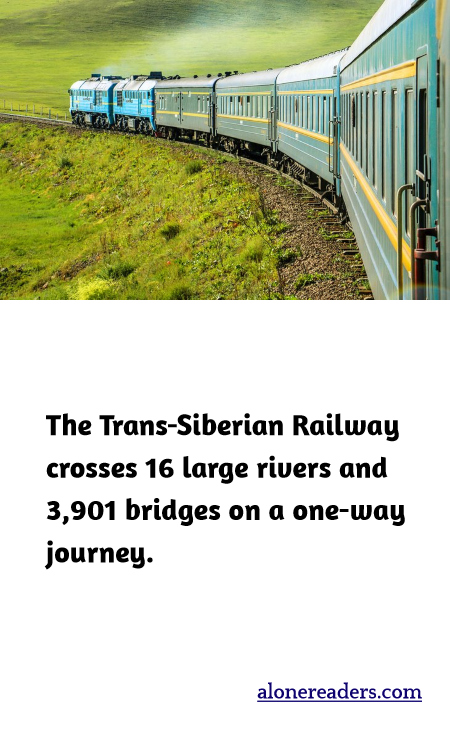
Spanning over 9,289 kilometers and connecting Moscow to Vladivostok, the Trans-Siberian Railway is not just a feat of engineering but a lifeline that stitches the vast expanses of Russia together. On this epic journey, travelers and freight alike traverse a landscape that is as diverse as it is expansive, crossing 16 large rivers and navigating an astounding 3,901 bridges.
The construction of the Trans-Siberian Railway was an ambitious project that began in 1891 under the rule of Tsar Alexander III. The sheer scale of the construction is hard to overstate. It required laying tracks through dense forests, over rugged mountains, and across endless steppes, often in conditions that ranged from oppressively hot summers to brutally cold winters.
Among the most significant rivers the railway crosses are the Volga, which is the longest river in Europe, and the mighty Amur, which serves as a natural border between Russia and China. Each river crossing presented unique challenges. For instance, building a bridge over the Amur was particularly daunting because of its width and the swift current. Today, the bridge stands as a testament to the engineering prowess of its builders.
The bridges, each a crucial link in this chain of steel across the land, vary widely in their construction. Some are modest, built with local materials and suited for the lesser streams and rivers, while others, like those over the larger rivers, are massive undertakings involving advanced engineering techniques and significant manpower. The bridges not only had to be sturdy to accommodate the heavy freight trains but also had to withstand the harsh Siberian weather.
Traveling the Trans-Siberian Railway offers a window into Russia’s soul, showcasing its natural beauty and the industrious spirit of its people. From the dense birch forests of the west to the lake-dotted landscapes of Siberia, and finally to the rugged coastline of the Pacific Ocean, the journey is as mesmerizing as it is long.
The construction of the Trans-Siberian Railway had a profound impact on the development of the regions it connected. It facilitated easier movement of goods and people, helped in the exploitation of rich natural resources, and played a pivotal role in military movements. Today, it continues to be a vital artery of trade and travel in Russia, a historical monument on wheels that offers a unique glimpse into the country's expansive geography and diverse cultures.
