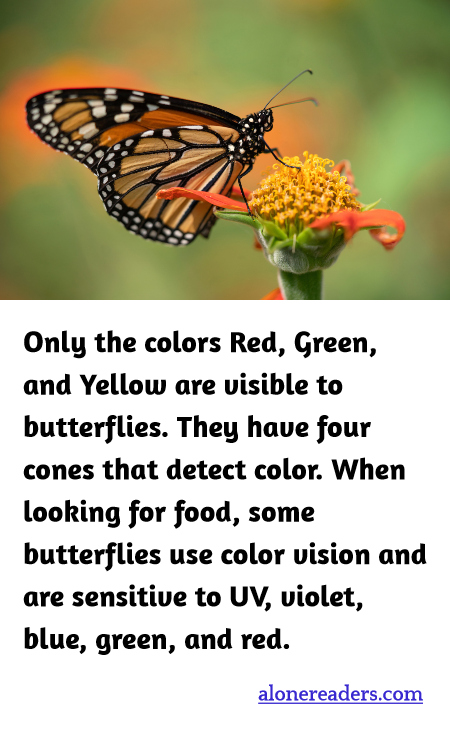
Butterflies are among the most visually fascinating creatures in the animal kingdom, not only for their vivid patterns and colors but also for their unique visual capabilities. Surprisingly, butterflies can only perceive three colors: red, green, and yellow. This is due to their possession of four types of color-detecting cones in their eyes, unlike humans who have three. This adaptation is crucial as it affects their behavior, particularly in how they forage for food and select mates.
The color vision of butterflies plays an essential role in their survival. While searching for nectar, butterflies are attracted to certain colors of flowers that stand out from the surrounding vegetation. The ability to see red, green, and yellow helps them in identifying the right flowers on which to feed. However, butterflies go beyond just these three basic colors; they are sensitive to ultraviolet (UV) light, which is invisible to the human eye. Many flowers have patterns that are only visible under UV light, and these patterns can guide butterflies to nectar sources.
Moreover, this unique vision helps in the mating process. Butterflies are often seen gathering on patches of brightly colored flowers, where males are likely to find receptive females. The ability to perceive a broad spectrum of colors including UV, violet, blue, green, and red allows butterflies to better recognize and select potential mates, as many butterfly species display these colors vividly on their wings.
Interestingly, the butterfly's sensitivity to UV light not only aids in finding food and mates but also in navigation. They can use UV light patterns in the sky, which are invisible to humans, to orient themselves and maintain their flight paths.
Understanding the color vision of butterflies not only enlightens us about the complexities of these seemingly delicate creatures but also about the intricate ways in which evolution has shaped the senses to adapt to specific ecological niches. This fascinating aspect of their vision is a reminder of the many marvels of the natural world, showcasing how organisms develop special traits to interact with their environment effectively.
