More About This Card
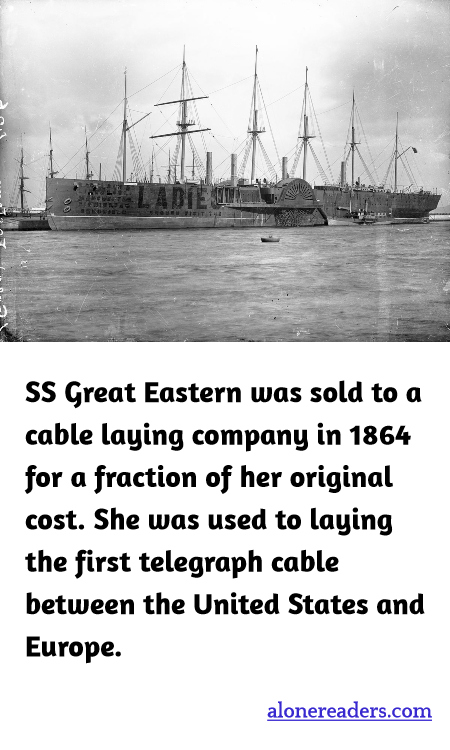
The SS Great Eastern, once hailed as the largest ship ever built during her launch in 1858, found a novel rebirth in her latter years as a key player in the burgeoning field of global communications. Engineered by Isambard Kingdom Brunel, the ship's scale and innovative design—featuring a double hull and immense length—initially aimed to revolutionize long-distance passenger and cargo travel. However, her commercial success as a transatlantic liner was marred by a tumultuous operational history that included financial difficulties, technical failures, and lackluster passenger numbers.
By 1864, her fortunes took a drastic turn when the Great Eastern was sold to the Telegraph Construction and Maintenance Company for a fraction of her original cost. This sale marked her transition from an underwhelming maritime player to a pioneering cable-laying vessel. The ship's massive hull and spacious decks, viewed as excessive for standard naval requirements, proved ideal for housing the extensive lengths of cable needed for one of the most ambitious projects of the time—the laying of the first transatlantic telegraph cable.
The Great Eastern embarked on this new chapter in 1865. The ship's role was to facilitate direct communication between the United States and Europe, specifically connecting Newfoundland in Canada to Valentia Island in Ireland. Her first attempt to lay the cable was fraught with difficulties, leading to the cable snapping and the mission being temporarily aborted. However, undeterred, the Great Eastern returned in 1866 and successfully completed the task. This monumental achievement effectively shrunk the world, reducing the time it took for messages to be transmitted across the Atlantic from weeks to mere minutes.
This venture not only heralded a new era in global communication but also marked a significant turnaround in the fortunes of the Great Eastern herself. She continued to lay cables across various parts of the world, including a link from Bombay to Aden, vastly expanding the globe's communication network. Through these endeavors, the Great Eastern secured her legacy, not as the passenger liner she was originally intended to be, but as the vessel that connected continents and people in ways previously unimaginable.
These contributions cemented the Great Eastern's place in maritime and communication history. Though she was eventually scrapped in 1889, the effects of her work in laying down the foundational structures of modern global communications are felt even today, showcasing a remarkable transformation from commercial failure to a symbol of technological progress.