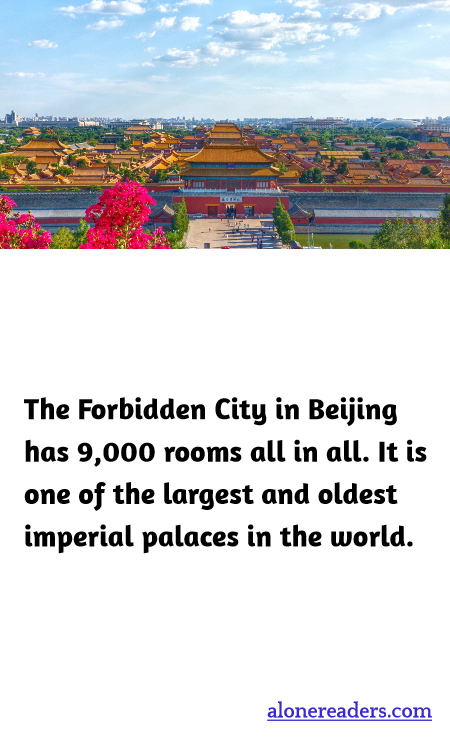
The Forbidden City, located in the heart of Beijing, stands as a monumental testament to China’s rich imperial history. Constructed during the Ming dynasty from 1406 to 1420 under the orders of Emperor Yongle, this vast palace complex spans approximately 180 acres and includes around 9,000 rooms. With its grand scale and well-preserved architecture, the Forbidden City is not only one of the largest, but also one of the oldest surviving imperial palaces on the globe.
For nearly 500 years, the Forbidden City served as the Chinese imperial palace and was the ceremonial and political center of the Chinese government. It was home to 24 emperors—14 from the Ming dynasty and 10 from the Qing dynasty. The design of the Forbidden City, a model of traditional Chinese palatial architecture, has exerted great influence on cultural and architectural developments in East Asia and elsewhere. The layout is meticulously planned to reflect philosophical and religious principles, signifying the majesty and sanctity of imperial power. Key buildings are aligned along a north-south axis, traditional in Chinese architecture, with the main gates facing south.
Each room in the Forbidden City had a unique purpose, such as housing emperors and their families, conducting meetings, ceremonial and ritualistic purposes, or storing documents and treasures. The extensive quarters of the Forbidden City are surrounded by massive defensive walls and a moat, which further illustrates the might and grandeur of the Chinese empire during its zenith.
The Forbidden City remains one of the most visited museums in the world, now known as the Palace Museum. It houses an extensive collection of artwork and artifacts, showcasing centuries of Chinese art and culture. Since 1987, it has been listed as a UNESCO World Heritage Site, celebrated for its architectural grandeur and immense historical significance. The rich detail and craftsmanship visible in its halls, gates, and towers draw millions of tourists each year, each eager to step into the vast courtyards and imagine the echoes of the past.
This majestic palace complex not only tells the story of China's imperial past but also serves as a symbol of the historical continuity and cultural depth of this ancient civilization. Its influence can still be felt today, not only in China but across the world, where it stands as a beacon of cultural longevity and architectural splendor.
