More About This Card
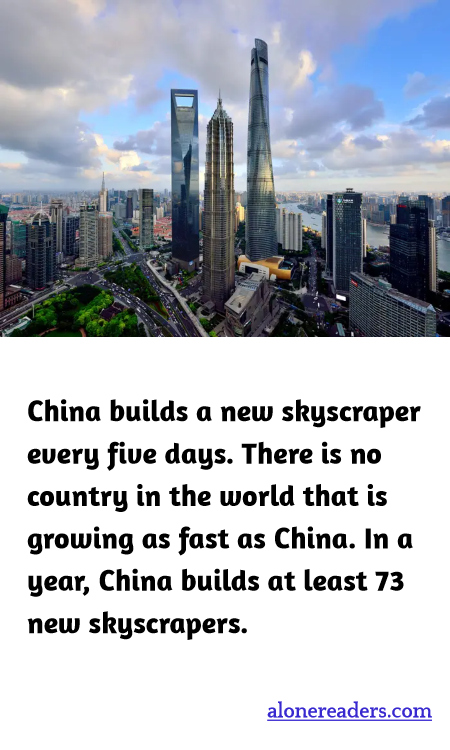
China's rapid urbanization and economic growth are vividly illustrated by its accelerated construction of skyscrapers. Building a new skyscraper every five days, China outpaces any other nation in transforming its skylines and expanding its urban landscapes. Within a single year, the country completes at least 73 skyscrapers, a testament to its ambitious development policies and the robustness of its construction industry.
This phenomenon is driven by several factors. First, the migration from rural areas to cities has surged in recent decades, pushing demand for urban living space. Cities like Shanghai, Beijing, and Guangzhou have expanded vertically to accommodate this influx, as horizontal expansion options are limited by geography and population density. Secondly, skyscrapers represent economic growth and are often seen as symbols of modernity and progress. They attract foreign investment and boost local economies by housing businesses and luxury apartments.
Furthermore, the Chinese government supports infrastructure development as a means of stimulating the economy. Large-scale construction projects, including skyscrapers, are often encouraged through policy and funding, aligning with broader goals of modernization and global economic positioning. The construction sector, featuring both state-owned and private enterprises, utilizes this support to push the boundaries of architectural design and engineering.
However, this rapid construction raises questions about sustainability and long-term urban planning. The environmental impact of such vast construction, including carbon emissions and resource depletion, cannot be overlooked. Urban planners and environmentalists are increasingly advocating for sustainable practices in building designs, including energy-efficient systems and greener materials.
In addition, there are economic risks associated with rapid building, such as potential real estate bubbles. With the 2019 surge in office vacancies in megacities, concerns about overdevelopment have surfaced, prompting discussions about the balance between growth and market demand.
Overall, China's strategy of constructing new skyscrapers at an unprecedented rate highlights its aim to redefine urban environments and assert its place as a global powerhouse. However, it also underscores the need for cautious evaluation of environmental impacts and economic sustainability in the face of such rapid urban development. As China continues to build up, the world watches closely, analyzing the implications of its skyscraper-laden path towards modernization.