More About This Card
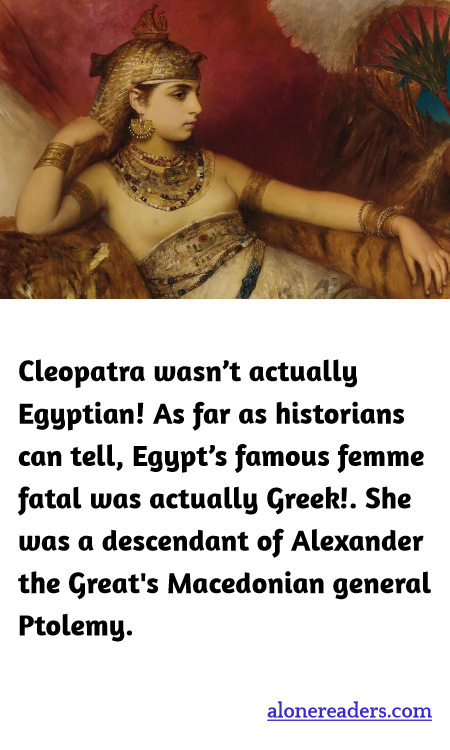
Cleopatra VII, often simply called Cleopatra, is one of the most famous figures in ancient history, known not only for her seductive prowess and dramatic life but also for her political acumen. However, contrary to popular belief, Cleopatra was not ethnically Egyptian but Greek. This surprising aspect of her heritage is rooted in the history of the Ptolemaic Dynasty from which she hailed.
Cleopatra was a member of the Ptolemaic dynasty, which ruled Egypt from 305 BC to 30 BC. The dynasty was established by Ptolemy I Soter, a Macedonian general and companion of Alexander the Great. After the death of Alexander in 323 BC, his empire was divided among his generals, and Ptolemy took control of Egypt. There, he declared himself King Ptolemy I and established a dynasty that would last nearly three centuries.
As a dynasty of Macedonian Greek origin, the Ptolemies retained their culture and continued to speak Greek, which was the court language throughout their rule. They also favored Greek customs, and marriage among siblings was practiced, a tradition that was common in both Greek and Egyptian royalties at the time to preserve royal bloodlines. Cleopatra herself was a product of this lineage, born to Ptolemy XII and believed to be his cousin-wife, Cleopatra V.
Despite her Greek ancestry, Cleopatra was the first in her family to embrace the Egyptian culture fully, learning the Egyptian language and adopting Egyptian customs. She also participated actively in religious rituals important to the Egyptian people, which endeared her to them. Cleopatra even represented herself as the reincarnation of the Egyptian goddess, Isis.
Cleopatra’s reign was noted for her efforts to defend Egypt from the expanding Roman Empire. Her involvement with Roman leaders Julius Caesar and Mark Antony was as much about romance as it was about politics. Her alliances with these powerful Roman figures were crucial in her strategy to protect the sovereignty and stability of her reign over Egypt.
So, while Cleopatra is often thought of as an Egyptian queen—and indeed, she was queen of Egypt—her lineage and culture were primarily Greek. This blend of Greek and Egyptian identities, however, allowed her to craft a unique persona that has captivated historians and the general populace alike for centuries. Her ability to navigate such diverse cultural dynamics is just one testament to her skilled leadership and intricate personality. Thus, the legacy of Cleopatra remains not only as a political tactician and leader but also as a bridge between Greek and Egyptian civilizations, making her one of the most intriguing figures of the ancient world.