More About This Card
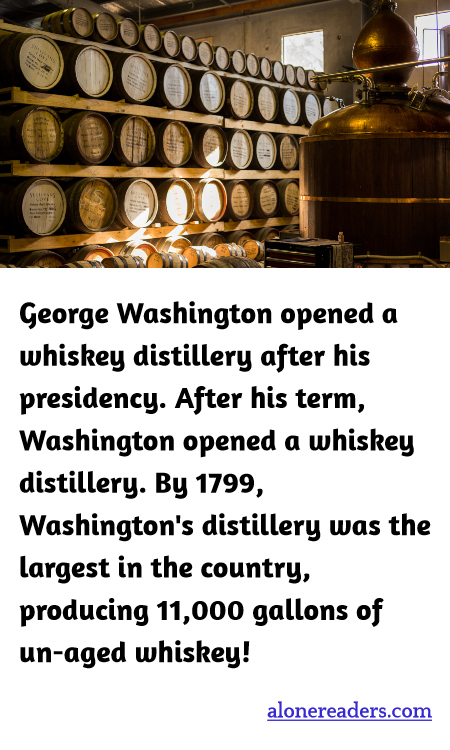
After serving two terms as the first President of the United States, George Washington returned to Mount Vernon, where his entrepreneurial spirit led him to venture into the world of whiskey production. The idea was suggested by his Scottish farm manager, James Anderson, who believed that a distillery would be a profitable extension of Washington's already successful farming business. Taking this advice, Washington established a distillery in 1797, just steps away from his flourishing gristmill.
Initially, the operation was modest, but by 1799, it had expanded to become one of the largest distilleries in America at that time, producing over 11,000 gallons of whiskey. The whiskey was made primarily from corn and rye grown on Washington’s vast estates, and it quickly gained a reputation for quality. This rapid growth in production was a testament to Washington’s acumen as a businessman and his ability to adapt and innovate, even beyond his political career.
Washington’s whiskey was an un-aged spirit, typical of the time, clear and potent. Despite Washington’s initial reluctance to enter the whiskey business, the distillery turned out to be a lucrative endeavor, adding significantly to his post-presidential income. In its peak year of 1799, the distillery’s success underscored Washington's forward-thinking approach to agriculture and business, demonstrating his ongoing commitment to economic development and innovation.
Today, Washington’s distillery at Mount Vernon has been reconstructed and operates as both a museum and a working distillery, where small batches of whiskey are made using the original methods and recipe from Washington’s time. This venture into whiskey distillation is an often overlooked aspect of George Washington’s legacy, revealing a side of the first president that blends entrepreneurial spirit with the pioneering American ethos.