More About This Card
In the medieval period, European legal systems often extended to the animal kingdom in ways that modern minds might find perplexing or even bizarre. One of the most striking examples of this is the execution of a pig in France in 1386. This event underscores the vastly different legal and moral frameworks of the time.
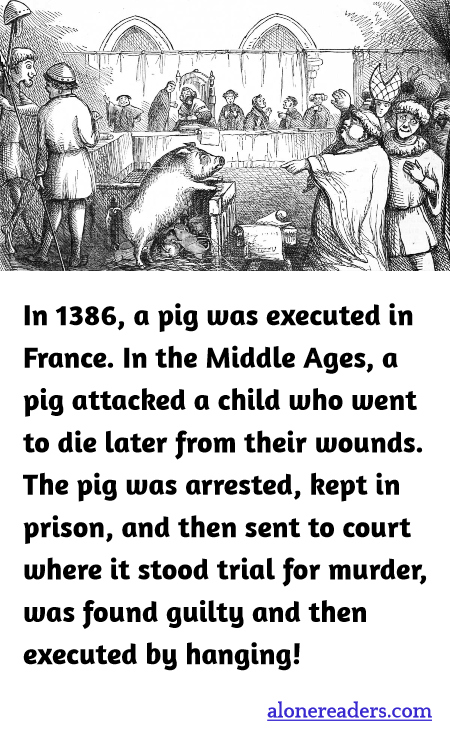
The case unfolded when a pig attacked a child in a French town. Tragically, the child later succumbed to the injuries inflicted by the pig. Following the incident, the pig was treated not as a mere animal, but as a rational being capable of committing a crime. It was arrested and placed in prison, a startling reflection of how seriously such incidents were taken.
As part of the legal proceedings, the pig was brought to court, resembling a human trial with all its formalities. It was subjected to a trial where it was found guilty of murder – a charge that, to the sensibilities of the time, required deliberate volition akin to human intent. The court decided that justice could only be served through the execution of the pig, which was subsequently hanged.
This incident reflects the anthropomorphic way in which animals were viewed in medieval society. Animals, like humans, were seen as part of the moral and legal order, capable of committing crimes and thus liable to prosecution and punishment. This notion sprang partly from a view of nature influenced by religion and the natural law philosophy, which posited a universe with a moral order that all creatures, human or animal, were bound to.
Moreover, these trials were not merely about punishing animals but served broader social and religious functions. They were spectacle and morality plays rolled into one, demonstrating the rule of law and reaffirming the community's shared values. An animal's execution would have signalled a reaffirmation of social norms, acting as both a deterrent and a cathartic resolution for the community's sense of violation when a human life was lost.
In the broader context of history, the case of the executed pig in 1386 is a fascinating glimpse into how societal norms, justice systems, and human-animal relationships have evolved. It challenges us to consider how our current legal and ethical standards might be viewed by future societies, just as we look back on medieval practices with curiosity and disbelief. The past, with its peculiarities and judgments, remains a vital mirror reflecting our own time's complexities and evolving legal philosophies.