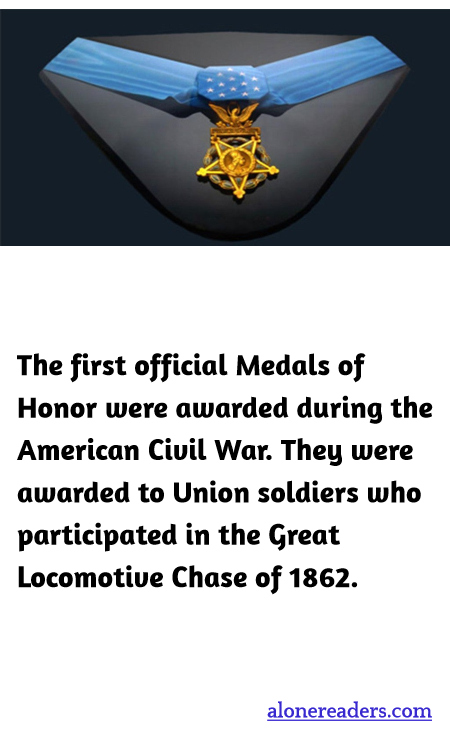
The Medal of Honor, the United States' highest and most prestigious military decoration, recognizes U.S. military service members who have distinguished themselves by acts of valor. The inception of this revered award dates back to the American Civil War, a conflict that tested the bounds of bravery and strategic warfare.
It was during this tumultuous period that the first Medals of Honor were awarded, specifically recognizing the valorous acts of soldiers involved in the Great Locomotive Chase of 1862, also known as the Andrews Raid. This daring mission unfolded in April 1862, involving Union volunteers from various Ohio regiments, who embarked on a covert operation deep into Confederate territory in Georgia. Led by civilian scout James J. Andrews, their objective was to steal a train and disrupt the vital Western & Atlantic Railroad between Atlanta and Chattanooga.
The raiders captured a locomotive named "The General" in Big Shanty, Georgia, now known as Kennesaw, and proceeded northward toward Chattanooga, destroying track, telegraph lines, and other railroad infrastructure along the way. However, their mission ultimately failed when they were pursued and captured by Confederate forces. Several raiders, including Andrews, were executed as spies. Nonetheless, the audacity of their actions did not go unnoticed.
Following the establishment of the Medal of Honor in December 1861, Secretary of War Edwin Stanton decided to award the first medals to participants of the Andrews Raid. On March 25, 1863, six of the surviving raiders became the first recipients of the Medal of Honor in a ceremony acknowledging their courage and initiative. Overall, nearly half of the 24 raiders were eventually awarded the Medal of Honor, reflecting the significant impact of their deed on the Union war effort and military history.
The inclusion of the Great Locomotive Chase in the annals of Medal of Honor history underscores the importance of behind-the-lines operations and the extraordinary valor required to undertake such missions. The story of the Andrews Raid not only highlights the strategic ingenuity of Union forces during the Civil War but also sets a precedent for the type of heroism and sacrifice embodied by future recipients of the Medal of Honor. Over the decades, the criteria for receiving this medal have evolved, but the heroic essence captured during the Civil War remains a defining characteristic of the award.
